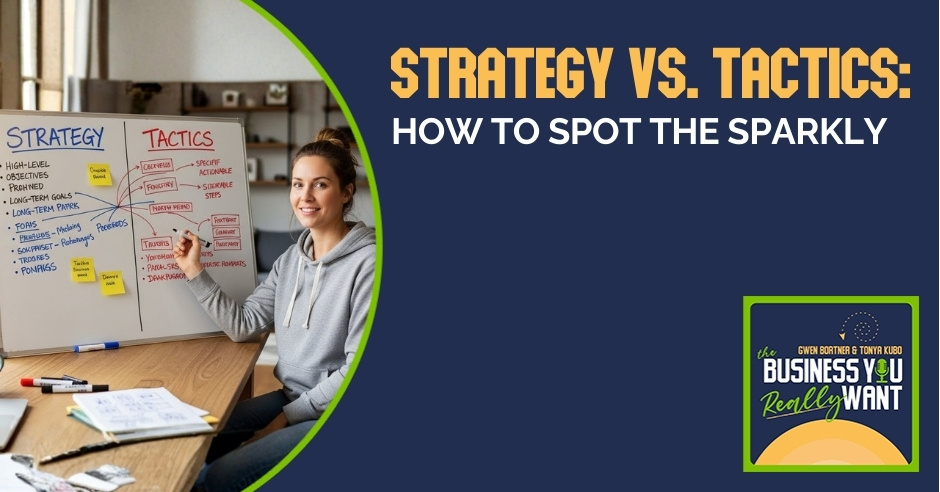
Most CEOs don’t have a motivation problem — they have an alignment problem. And nothing derails alignment faster than sparkly tactics that feel productive but don’t actually move the business forward.
In this episode, Gwen Bortner and Tonya Kubo dig into the real difference between strategy and tactics, why entrepreneurs so often confuse the two, and how to avoid being seduced by the “new, shiny thing” everyone else seems to be doing. Learn how to focus on real strategy, define your constraints, and spot the signs of a non-productive, “sparkly tactic.”
—
Watch the episode here
Listen to the podcast here
Strategy Vs. Tactics: How To Spot The Sparkly
Strategy Vs. Tactics: Why CEOs Confuse The Two
A business can be incredibly busy and still actually going nowhere. Most CEOs, at least the CEOs I know, CEOs Gwen knows, don’t have a motivation problem. They have an alignment problem. In this episode, what Gwen and I are going to do is talk about the difference between real strategy and all those sparkly, exciting tactics, especially this time of year, that steal your time and attention without actually moving your business forward. Gwen’s going to be here to help us separate the two so that the work that you choose to do this year actually matters. Gwen, let’s take it from the top and tell me why you think CEOs might confuse strategy with tactics.
Tactics are so fun. It’s a little bit of what we were talking about in our previous episode. It’s the doing. It looks like we’re doing something. We’re very excited about doing things. Tactics is a way to execute a strategy. It is not necessarily the strategy. I think that’s the piece that people struggle with. It’s easy to conflate the two from time to time. It’s like, “My strategy is to start a podcast.” We’ve used this as a thing, and it’s like, but is that actually a strategy or is that just a tactic?
It’s an activity. Quite honestly, if it’s an activity, it’s a tactic. Strategy is so much more about your unique context and how you are applying it to your unique context. It’s a little nebulous, and I think that’s why a lot of people don’t necessarily think about strategy and how this is actually going to change their business. It’s much more about, “This is the thing I can do and doing makes me feel valuable and useful,” and all of those words that we put toward those kinds of things.
I think the best definition, and this is one I lean on heavily if I’m going, “Is this a strategy or is this a tactic,” is Seth Godin, who says, “The strategy is what you keep doing when the tactics fail.” Let’s take the case of Facebook ads, because you can have a Facebook ad strategy, because there are a lot of tactics involved in running Facebook ads.
However, if your ads aren’t performing well, and you’re like, “We’re going to pull all ads,” then the ads were a tactic that should have been feeding into a larger strategy. Maybe the strategy is, “I want to be the best-known community strategist out on the market, and Facebook ads are my way of doing that. My way of making sure that everything knows about me.” Ad spend is too high, I’m not getting the numbers I want, so I turn off ads, and then I figure out a different tactic of making sure that other people know about me in this realm. If you’re going to turn it off or on, it’s not a strategy. That’s a tactic.
What I would say is, if it’s using a particular platform or tool or activity that can be replaced by any other tool or activity, that tool or activity is the tactic. It’s not the strategy. I’m going to keep using podcasting as an example. Podcasting in and of itself is a tactic. I don’t care how you’re using it. You may be using it strategically, but it’s still a tactic because there are multiple ways that you can get your voice out to the world for whatever purpose you’re using your podcast for.
Whether it’s to create new clients, to get more awareness, to have people understand how you talk about things, there are thousands of ways to do it. It is in and of itself never a strategy. It’s a tactic toward a bigger strategy. It may be the key tactic in a strategy. At some point, just because we’ve seen it with so many things, time could say, “Yeah, podcasts are no longer a thing. We’re just not doing podcasts at all,” but if we’re still getting a result from that process that’s answering a problem, whatever the new thing it is, then the podcast was just a tactic.
I just spent some time with Nick Peterson again, and one of the things they talked about was the hierarchy. I think it’s an important thing for people to think about of, there’s philosophy, which is what our beliefs are, then there are principles about how we want to do things. There are strategies, then there are tactics, and then there are tools. Using the podcast as a tactic, we use Riverside as our tool. We could use Zoom as our tool. We could not record video at all and it would still be a podcast. We do a podcast/videocast.
All of these things are part of the tactic, but we could also just go live on Instagram. It wouldn’t technically be a podcast, but it might still get the same result for whatever strategic problem we’re trying to solve. If there’s more than one way to approach it, it’s probably a tactic that you’re doing. The problem that we’re trying to solve, that’s where the strategy comes in.
I think part of the challenge is that strategy is a slow game. It’s a long game.
It’s a very slow and very long game.
It feels better to say like, “Our strategy for marketing was podcasting. Podcasting didn’t work, so now we’re live streaming. Live streaming didn’t work. Now we’re putting your face and my face on billboards on the side of Highway 99.” I don’t recommend it, but we could. It’s an option. Somebody would take our money, I’m sure. I think the problem is there’s no dopamine hit to strategy. That’s what I think the problem is. I think we as entrepreneurs, love dopamine hits.
The problem is there's no dopamine hit to strategy. Share on XWe love the dopamine hit. I think the issue related to that is good strategy is actually hard to develop.
How To Develop Real Strategy
Tell us what it looks like. Let’s go there. That was on my notes anyway. What does real strategy look like?
I think the first is that we have to understand what is the problem that we’re actually trying to solve or address. That’s another thing. This is the classic sounds simple, technically is simple, not easy because real strategy is focused on a problem, a specific problem. Often, we want our tactics to address all of the problems. What really is the problem? Figuring out the problem, the real problem is hard. What we like to find is the problem, we talked about this in the previous episode, is it’s so much easier to focus on the symptoms as opposed to the root cause. Often, we’re putting strategy around symptoms, which technically could still be strategy, but it’s probably not good strategy.
Real strategy takes a lot of self-reflection, takes a lot of digging, takes a lot of answering the question. It’s the question that comes up at Genius Network quite often. What is 1 problem that if solved would 100 other problems? Most of the time, when we think we’re doing strategy, and I’d love to say I’m not guilty of this, but that would be a lie. I’m guilty of it too. I think we all get stuck on solving the thing that seems the most obvious. Not always, but usually the thing that’s most obvious is a symptom. It’s not actually a root cause. Digging into that root cause is hard and is often painful.
We often avoid it or we go for what I would call the easy answer as opposed to saying, “Why is that true?” It’s the classic asking the why until you actually get down to the real root problem. “I need more clients.” “Why do you not have more clients?” Answer that question, but why is that true? To get really down to what the real issue is, that’s the problem that we need to solve strategically. Usually, the strategic answer has probably at least several, if not dozens of possible tactics that functionally probably all have potentially the same likelihood of working. We just need to pick one.
Defining Your Constraints To Pick The Best Tactics
To follow that thread, the first thing is get clear on the problem you’re trying to solve so that you have clear direction. It’s really about defining your constraints because like you said, there’s no shortage of tactics that are likely to work, but if you can define constraints, then usually, the best ones for this specific set of circumstances will be fairly obvious.
Get clear on the problem you're trying to solve so that you have clear direction. Share on XUsually, then it really comes down to, as one of the constraints, what either makes the most sense or feels right. When we were talking about this show, we were headed down an audio version only option for quite a while. However, I actually like being on video. I don’t have any problem being on video and realize that no, this needs to be video.
Part of the tactic of the show is for people to understand what it’s like to work with me. The way they work with me is me on video. It’s getting comfortable with seeing me on video and hearing me talk on video and the way that I talk on video. It’s like, no. Audio would be okay. Of course we have an audio version as well. It’s like, no, the video actually is a tactic, but it’s part of solving the strategic problem.
When we go to what’s the purpose of the show, then going, what are the constraints? We want the show to feel as much like having a conversation with you would. Whether it’s the person listening becomes a client, this feels like an extension of what they already know to be true. Whether they become a referral partner or they want to invite you into their networking community, or they want to join your networking community. We want this to be an extension of that comfortable pro-social relationship that they’ve developed. Of course, all of that means that it can’t be audio only because last I checked, you do very little telephone work these days.
Very little. I had a call because someone’s like, “I got stuck. I’m still driving. Can we do it as a phone call?” “Yeah, of course we can. I have no problem with this.” It wasn’t a brand-new client. It was someone I’ve worked with literally for years and years and it’s like you know in the inflection of my voice what my face also looks like. You’re getting the full piece because we have enough relationship for it. There was strategic choices made about the show as using this as a tool to one of the things that we were looking to solve.
The Strategy Trap: Why You Must Constantly Evaluate
Real strategy. It’s a very specific problem you’re trying to solve. That’s the clarity that gives you your direction. You define your constraints based on that direction. Your tactics really are the actions that you have chosen that align with solving the problem within those constraints like we just talked about. We want people to have as much comfort being on the call with you as possible. That is what drove a video podcast in addition to an audio podcast. Finally, and this is something that I think people rely on you for, but that you’re really good about doing in your own work as well, which is constant evaluation. We don’t set a strategy and forget it for a year.
Absolutely not. That’s a huge place because it’s so easy to say, “Yeah, we’re just going to do this now.” At the same point, it’s important to continue to focus on we are giving it enough time to solve the problem.
Definitely need to give it enough time. Also wanting to make sure that you don’t give it too much time. Back to we have to evaluate it more than once a year. I know you advocate for at least once a quarter. Some strategies need to be evaluated monthly.
Mostly for strategy. Tactics may need to be evaluated monthly, but usually, the strategy needs to be evaluated quarterly and/or yearly. It can become very apparent very quickly. It’s like, “I put a whole lot of money into this and I haven’t seen anything and everything in our planning and process and application of this tactic said we should be seeing results in two weeks and it’s been a month.” It’s like, are we actually convinced another month is going to change the results? That’s a tactic. Do we still have the problem? Do we still need to have the solve the problem? Yes. Do we need to take another tactic on it?
What we may realize is like, “Yeah, this actually isn’t the problem. Maybe we do need to dig into the strategy again. We’re working on a symptom.” Most of the time, if we actually have a really good strategy that we’re working toward, usually the strategy isn’t the problem up to 90 days or 6 months. Beyond that, if it’s not lasting that long, then you really should be asking the questions like, are we actually solving the root cause or are we just dealing with symptoms?
The Biggest Clues You’re Falling For A Sparkly Tactic
Let’s talk about how the sparkly tactics like to show up, because sometimes they take us by surprise. Sometimes we really do believe that this is a strategy that we’re working on, or we believe that it’s a variation of what we’re already doing and we don’t realize it’s a distraction. What are some catchphrases or some clues that you use to help identify whether something is a sparkly tactic or actually the path that we’re supposed to be headed on?
The sparkly pieces is always around the, “I just thought of,” “Someone was talking to me about,” “I saw this on,” fill in whatever blank. That’s always the first clue that we are dealing with sparkly. We’ve got sparkly issues going on here. Whenever we have sparkly issues, the first thing is to say, “Is this really a tactic or are we actually dealing with strategy?”
The other piece is to be asking, could this be substituted or is this substituting for something else? Back to sparkly tactic. “I’m no longer going to do Facebook ads, but I’m going to do LinkedIn ads.” Those are sparkly tactics. I’m going to stop doing DMs and LinkedIn. I’m going to start doing DMs and Facebook.” Sparkly.
I think the biggest cue to me that it’s a sparkly tactic is anything that starts with, “Everyone else is doing it,” or like you said, “I saw so and so do this.” The reason that I say that is my cue is because all we can ever observe of somebody else is their tactics. Tactics are behaviors, their actions. That’s the only thing we’re privy to. If I saw somebody on Instagram do a thing, I am providing commentary on their tactic.
Strategy Vs. Tactics: How To Spot The Sparkly Share on XI’ll use a fairly relevant timely example, which is, “Comment X word below.” We see this on social media all the time. “If you want, if you are in, if you’re interested, whatever it is, comment question below.” What we started to see people were like, “I see a lot of people are putting like comments such and such below. I’m going to start doing that,” not having any idea why they’re doing it.
They’re like, “I saw people do this and then there’s like a bunch of comments and so I’m going to do this and I’m going to get a bunch of comments, or I’m going to do this because I saw them promoting their lead magnet that way, and I’m going to get a bunch of interest in the lead magnet.” Not realizing that is a tactic that fulfills a strategy that usually has an automation attached to it.
Most of the people who are doing that have some tool, Minichat is one of them, that when people drop the keyword, it sends them an immediate direct message. It has the ability to do a direct delivery of whatever the promise is. The person isn’t actually babysitting their Instagram account 24/7 so that they can respond to every comment as it pops up and send that DM delivery. They’ve got some tools behind it. That’s probably attached to a whole sales process.
If all you do is see the, “Comment X word below,” and you decide to jump on that train and you don’t have any of the underlying infrastructure to support it, first of all, you are not even going to know if it’s working or not because you don’t have any awareness of the strategy that this is trying to fulfill. How can you evaluate it? You also don’t know what you’ve gotten yourself into if it starts being as successful for you as it is for other people.
This is where strategy context matters. Tactics, in and of themselves, the context doesn’t matter. The tactic is the tactic. There’s still a little bit of context, but strategy, the context really matters. What is the specific problem that is unique to you in your current journey on your entrepreneurial path that we’re trying to address? Using the example you just said, if it’s just getting more comments in, maybe this will work, but do we know why we’re getting more comments? What are we trying to do with the more comments?
With strategy, context really matters. The question is what specific problem is unique to you and your current stage on your entrepreneurial journey that you’re trying to address. Share on XIs it a way to get more people into our email list? It’s still a strategy and there’s a reason for it, but is this the way that you’re going to do it? Are your people, the people who are going to do that on LinkedIn or Facebook or Instagram or wherever that are going to actually create that? Is that the thing that is the way that it’s going to work for your particular context? Is that the thing that you need right now?
I know we’ve talked about it before, but it’s where someone’s trying to do the build a giant list tactic because they’ve seen others do it, but their product doesn’t actually need or support a giant list. It needs a small list of really motivated exactly right people for it. It’s really easy to say, “That’s my tactic. We need to do this.” It’s like, “Is that what we really need?”
Visionary Brainstorms: Why You Should Put Good Ideas In A Parking Lot
Just to recap this part, you know it’s a sparkly tactic usually. If anybody says, “Try this thing, it’ll only take a minute. If everybody else is doing it, so we should try it too. I just saw whatever person say this,” those are hints that this could be a distraction. Now I am coming to the hard part of this conversation, Gwen, because I know you work with visionary business owners. I tend to attract a visionary business owner. I think those of us who are a bit analytical do.
How do we help the reader who’s listening to us right now and says, “You people are dream killers. Some of my best ideas have come in the middle of the night as a brainstorm when I was in the middle of doing something else. Do you mean to tell me, you expect me to put this amazing brainstorm in a parking lot? I would rather die eleven grizzly deaths than not have the opportunity to live out my creative dreams.” What do you say to that, Gwen? How do you help your clients not feel like they’re suffocating in boredom, but still help them stay on track toward their goals?
Part of it is to say, yes, I do expect you to put it in a parking lot because if it’s really good and exciting, it’ll be good and exciting tomorrow too. Sometimes it literally is tomorrow. I just want you to wait on this for a day or two before we start putting time and energy into it. That’s the first thing, because if it’s really a great idea, it will still be a great idea.
Good ideas do not have an expiration date. They can’t have an execution date that needs to happen. I’m not saying you need to put it on hold for five years, but it needs to be able to be on hold. The other thing that I spend a lot of times with my clients on is if we’re going to do this, then what are we going to not be doing?
Say a little bit more about why that might be important.
This is back to we only have a limited number of resources and we talk consistently about the three resources being time, money, and energy. Any new idea, any new activity, any new amazing brainstorm, however you want to describe it, is going to take probably some amount of each of those three things. It may take more or less, some more than others. It may take more money, but less time. It may take more energy and more time, but less money. Any combination of those things.
Any combination of those things could be happening. I rarely come across an entrepreneur who isn’t already leveraging most of their energy, most of their time and most of their money in some form or fashion. We usually can’t just keep stacking things on. If we do, often, that’s where we’re getting burnout. We have dozens of other episodes on those conversations. Part of it is, if this is so amazing, what that is not so amazing are you taking off the list?
I’m just going to keep using the show as the example for this particular episode. I could get all wound up about we need to be doing LinkedIn lives. That’s what we need to do. I would expect you to say, “What are we not doing that we were doing if we’re going to be doing LinkedIn lives?” It may be that we’re doing them in addition to the show, but it may be we’re going to do them instead of the show. Now we chose to do some LinkedIn lives but it was a very limited set. That was also part of it. It was part of the podcast celebration. It was part of the overall strategy. We had some thought about it, but it was like, “No, we can’t add that on, on top of everything else. We’ve got to make some choices somewhere in the equation.”
I don’t think I’ve ever had one of my entrepreneurs not at some point say, “I’ve got this great idea. We need to do such and such.” In fact, one of my clients, in her weekly course of action update, said, “I shared this new thing that I’m doing,” which is off her normal path, but it made sense for this particular piece. She said, “I got some great input and I got a whole bunch of other ideas.” My response was, “You don’t need any more ideas and you need to not be going off of your main track.” Ideas are not the thing that she lacks at all. It’s like, “You don’t need more ideas about what to do. You need to keep staying focused on the thing that you are doing right now.”
You don't need more ideas about what to do. You need to keep staying focused on the thing that you're doing right now. Share on XMake sure that you’re doing the very best that you can there because in this particular case, this is completely down, it’s not even like parallel because the thing that she came up with was just a little bit off track. Now it’s more things that are more off track of that. It’s like, “No, we don’t need to be doing this.” If everything was running smoothly and we didn’t really need to put much time into the business, then maybe you can start a new business. Maybe you can do something else. Maybe you can go down another path. Back to we’ve got to manage our time, our money, our energy. If we’re going to do something new, we probably have to stop doing something else.
I think that’s hard.
It’s not fun, by the way. It’s not a fun thing, which is why a lot of entrepreneurs struggle with it because it’s like, “That’s not fun.” It’s like, “This isn’t about it all being fun all the time. If it was easy, everyone would do it.”
Balancing Innovation & Discipline With The “Hobby” Rule
What I was going to say is there’s a way to balance the innovation and discipline. It just doesn’t quite look like a lot of entrepreneurs want it to look. What I think, and this is from my own experience as well, is you want to think of what’s a new way to get my name out there? What’s a new way to get leads? What’s a new way to get sales? That’s where we want to innovate.
There's a way to balance innovation and discipline. Share on XIn reality, sometimes the best thing that we can do is figure out a way to make the consistent behavior feel innovative. I know you had a client, this is probably one of my favorite examples ever. What she needed to consistently do is reach out to people. She did not have a leads problem. She simply had a nurture problem. She didn’t like doing outreach and so she developed a sticker system because she likes stickers. Stickers made her happy. Giving herself a sticker every time she did the outreach she knew she had to do, made the outreach feel innovative. It made it feel fun. I think that’s a way that we don’t always think about to feed that need for the new shiny stuff without actually veering off course.
The other thing that I find, and this will probably hit home for you because we’ve talked about it before, is one of the things that a lot of entrepreneurs do with their business is they treat it like their hobby. They’re trying to get all of their creativity and fun fed out of the business. It’s like, “No. The way I always have defined hobbies is that it should cost you money and it should be something you enjoy doing.” People are always like, “What do you mean cost you money?” It’s like, “Because that’s the nature of a hobby, that you’ve got to spend money on it.”
Not necessarily tons and tons of money, but most of us spend money on whatever our hobby is. I’ve had people say, “My hobby is running, so I don’t really have anything to spend money on.” It’s like, “How much did those shoes cost?” There are ways that we’re spending time and money on hobby. Hobby is actually the place that we should be investing our creativity most of the time and trying to get our need for the creativity fed.
The other thing is if we’re really doing hobby, if we’re truly hobby, so it’s not making money for us. We’re not trying to figure out how to have it make money for us. It’s just something we enjoy doing. That is in fact when our brain will get creative on the things that it actually needs to be getting creative on instead of trying to distract us. Let the hobby be the distraction.
If we're truly doing a hobby, then it's not making money for us. We're not trying to figure out how to make money; it's just something we enjoy doing. Share on XYeah, because that’s what hobby should be, rather than allowing your business to be a distraction, which is not what it should be because we expect an ROI on our business, we do not expect an ROI on our hobby.
I will say almost everyone, when I first meet with them, when I ask what their hobby is, they will talk about something that they used to do but haven’t done in years and years. It’s one of the things I try to encourage them to get doing early on. It’s like, “Start doing your hobby again.”
This is really helpful, I think, because there’s never going to be a time when we’re not confronted with a sparkly tactic. There’s always going to be something that’s the newest, latest, greatest hitting the market that everybody else is doing and they made $1 million doing it or so they say that is going to take or at least try to take our attention.
The thing that we need to do as business owners, and the thing that I think that you’ve helped us figure out how to do, Gwen, is how to stay the course. How to acknowledge that, yeah, that does look cool and not let that be a distraction from what we’re doing right now. How to make sure that we understand the difference between strategy and tactics. How to identify what real strategy looks like so that we’ve built a strong strategy. We haven’t just built a collection of tactics that are disguised as a strategy. Also, to recognize those shiny tactics for what they are and to make sure that we keep our creativity front and center without forcing our business to be a hobby, to be the source of the creativity.
I love your advice that if you don’t have a hobby, then get one. If there was something you used to love to do that you’ve stopped doing or that you’ve ignored, go back to it. Let that feed the need for creativity and novelty, I’ll say. Let your business be consistent, be reliable or, I don’t know, maybe be boring so that it can be sustainable. If you’re reading and you’re like, “I need some help here,” or maybe all you want to do is just practice the strategic thinking that we’ve been talking about, we’ve got an opportunity for you to do that week to week.
Gwen sends out an email every single Friday that just has one question is a strategic question. If you wonder whether you are good or bad at strategic thinking, sign up for the email series. See how uncomfortable the questions make you. See whether you have a hard time answering them or not. That’ll be a really quick answer to that question.
To sign up, go to EverydayEffectiveness.com/question. Every Friday, you’re going to get a question in your inbox. You can choose to reply to yourself, reply to us. If you reply to us, Gwen will actually take some time and respond to you as well. It is probably one of the best things and definitely the cheapest things you can do right now to move your business forward. We’ll see you next time.
Mentioned in This Episode
About Your Hosts
Gwen Bortner has spent four decades advising executives and entrepreneurs in 45+ industries. She helps women succeed in business without sacrificing happiness by identifying their true desires and aligning their business functions. She spots overlooked bottlenecks and crafts efficient plans toward sustainable success that center your values and priorities. Known for her unique approach to problem-solving and accountability through the G.E.A.R.S. framework, Gwen empowers clients to achieve their definition of success without sacrificing what matters most.
Tonya Kubo is a marketing strategist and community builder who helps entrepreneurs build thriving online communities. As co-host of The Business You Really Want and Chief Marketing and Operations Officer (CMOO) at Everyday Effectiveness, she keeps conversations on track and ensures complex business concepts are accessible to everyone. A master facilitator with 18+ years of experience in online community building, Tonya takes a people-first approach to marketing and centers the human experience in all she does.
