Operations strategist Ashlee Berghoff, founder of Smooth Operator, joins Gwen Bortner to talk about the evolution from independent consultant to agency owner—and what it took to make her business sustainable as her life and family grew.
Ashlee shares how she shifted from doing everything herself to building a team of fractional COOs and operations managers, and how becoming a parent forced her to rethink her time, energy, and definition of success. Together, she and Gwen dig into the emotional side of operations, from accountability without shame to learning how to work with your own motivations (including gold-star brains!).
In this episode, you’ll discover:
- How Ashlee recognized the business she built wasn’t aligned with the life she wanted
- The mindset shifts required to stop overworking and design a calmer rhythm
- Why constraining her time actually helped her do better deep work
- How she uses idea lists, capacity triggers, and clear constraints to stay on track
- What it looks like to grow sustainably—even when opportunities abound
If you’re a consultant, strategist, or service provider looking to grow without drowning, this conversation is filled with wisdom, practical systems, and honest reflection on what sustainable success requires.
Links and Mentions
Connect with Ashlee (https://www.linkedin.com/in/ashleeberghoff/)
—
Watch the episode here
Listen to the podcast here
Sustainable Success As A Consultant With Ashlee Berghoff
Our episode is the last in my series of What It Really Takes, where I have been chatting with clients about how they have reshaped their businesses to better align with their lives. In this episode, I am joined by Ashlee Berghoff, the system strategist behind Smooth Operator. Ashlee has built a successful operations agency, but like so many high-achieving consultants, she reached a point where the business she built was not fully serving the life that she wanted to live.
You will hear how Ashlee recognized it was time to pause, reassess, and make the intentional shifts so her business could support her values, particularly her desire to spend more time with her young family. It is an honest look at the evolution that many successful service providers eventually have to face. If you like what you hear and would like to chat more, please feel free to book a call at EverydayEffectiveness.com/clarity. Let us jump in.
We are here live with one of my former clients officially, but also one of my good friends and fellow operations person, Ashlee Berghoff. We were just talking about when we first met was through an organization called the Dames. Ashlee started a group called the Ops Pod for those of us who focus on operations. Often in these networking groups, most of the people are in sales or marketing, or not on the operations side of things.
It was nice to have you pull us together as part of that. Ashlee is joining us as our third person. She may be our final. We may end up doing a few more of these, but she is our last scheduled person at this point. Talking about sustainable success and what it takes in this case, as a consultant, but particularly an operations consultant.
I know that she and I are going to have great conversations because we always have great conversations, especially when it comes to talking about operations. Before we got on, we talked about that, although, especially when we first met a couple of years ago, we could have very much seen each other as competitors to one another.
One of the things that I have always loved about you, Ashlee, is that you do not approach it as competition. You approach it as collaboration. How can we work together, and how can we make things better for the whole instead of being so self-centered about how do I get all the business? How do I make it work? We are going to talk more about it, but since then, our roads have diverged a fair bit. I would not see us at all as competitors.
We are in different models now, yes.
We are definitely doing some different models. Ashlee, when we first started getting to know each other, I really appreciated you for jumping in and being willing to have this conversation, as well as a collaboration. Tell us about where your business is now as opposed to where it was when you and I first got to know each other. We are going to explore this transition because I think it is a huge transition as part of long-term sustainable success. Let me let you jump in and talk about your business today, and your business as it was.
The Evolution Of Smooth Operator: From Solo Consultant to Operations Agency
Thank you, Gwen. It is such an honor to be here. My business is called Smooth Operator. It was called A Squared until earlier this year. That was one of the more recent changes that have happened. When I started my business back in 2017, I started out as an ops generalist. I called myself an independent business manager, just came in and helped businesses with their ops, and pulled things out of their heads and magically made it happen.
A couple of years ago, so this would have been five years into my business when Gwen and I first met, I was really still trying to figure out the best way to balance being a strategist and coming in to look at workflow and the deep work of the operational strategy that I was doing for my clients, while also extracting myself from the business. Doing those two things at the same time felt really difficult. In our space, there are a lot of virtual assistant agencies, many of them. You see a lot of those. You see fractional COOs, but those are usually individual, independent fractional COOs. There is this growing space in the middle.
It was hard to figure out how to navigate that to have the strategy piece and the implementation piece and have both of those pieces not be things that I was responsible for independently. The way our business looks today is that I have fractional COOs and operations managers on my team, and they do the direct work of building processes and systems for our clients. We found the model that I feel really good about, but it took many years.
Parenthood & Entrepreneurship: Aligning Business Success With Family Life
I am assuming now, I am making a giant assumption, but I have good data that this assumption is based on. Correct me if I am wrong. Part of the change for you was that you started having children. Because when you first started the business, you did not have any children. Is that true?
That is true. My first daughter was born in 2019. Here they are now. I started my business a year and a half before I had kids, with the intention of having a business like this, that I could have the full autonomy to shape around the needs of our family as I grew. The business has survived a couple of maternity leaves and a lot of changes in our family in that process over the past few years.
I am assuming that is also part of what has driven some of the change as well. A lot of the women I work with have children in some capacity, meaning they are either small children, like you have, school-aged children, or they are nearing the end of their schooling. Some of them are empty nesters, and the children have officially flown the coop in some form or fashion.
As someone who opted out of having children, I am always impressed by anybody who can navigate entrepreneurship and children at any stage. Maybe not so much the flown the coop stage, but even sometimes that can be a thing. Of course, they are always your children until you no longer are.
They are coming home for the summer, or they need something from you, or whatever that looks like. They have kids now, and you are helping with them. I have a client who has grandkids and some schooling.
There is always something that is related when you have that. That was one of the things that you and I were talking about and that we were dealing with when you first came and started with us doing the weekly course of action. It was how to make this navigation work in a way that actually was going to work for you. What are some of the changes that you were able to make, both as part of this navigation, but also because of working through the WCA and thinking through some of these things?
When I joined the WCA, one of the things that came to mind for me was, “When I set out to do something for my business, from a strategic standpoint, I am going to write a book, or I am going to launch this thing.” All of the goals that I have set for myself in the past that were in my control, I would do those things. I am an ops person. I love getting things done and checking off the boxes and those sorts of things.
When I was looking at it, I was like, “I do not necessarily need accountability to do what I set out to do for my business. However, there is this whole other part of my life. Taking care of myself, making sure that my business stays within the time constraints I have set out to have for it.” Doing things that, when I realized I was dreaming of this future, a lot of the elements of that future were the slower pace of life, room to do slow cooking, and having a garden. It was like, “Wait, I do not have to wait until some future time to do these things.
There’s no reason to wait for some future moment to do these things—why are you not doing them now? Share on XWhy am I not doing these things now?” I use the WCA as the launch point and the accountability framework to help me start to do those things, to use the same energy and goal-setting frameworks I normally have used for my business for these other elements of my life. That was incredibly powerful just to realize that I could apply that same energy to making sure I worked out sometimes or shut off the laptop and truly unplugged after my hours were done, and those sorts of things.
The Gold-Star Brain: Applying Business Accountability To Personal Wellbeing
When people think about getting a project like the weekly course of action, using a tool like that, most people really only think about it from their business standpoint. It was one of the things that I love that you saw is like, “Wait a second, I can and maybe should apply it to my personal life.” How was that for you? A lot of times, we think about accountability in our business world, but we often do not think about it in our personal world, or we think that we can manage it ourselves. I am also a big believer in knowing that I am not managing my personal life accountability that well. How was that for you? It is a mind shift. How did that work for you?
There were a couple of pieces to it. One is that it felt more vulnerable, saying, “I am going to do this Instagram video,” and then not doing it is a little, still have to look at that and pay attention to it, but it is different to say, “I was going to sleep enough, and I did not and I cannot figure out why.” Some of these things that just are very personal. It is like, “I know how important this is for my life, for my ability to be a good present parent, to do my best at work. Why am I not doing it? Why can’t I do this?”
There was that extra layer of vulnerability. The positive side of it was that I realized that the same type of incentive structures that are motivating to me at work work there too. I am seeing this in my oldest daughter now, too. We are very gold star motivated. I just say gold star to my daughter, and she is like, “Yay.” I am that way, too. I can say to myself Gold star, like, “Yay.” I could use the same incentives for those things. For some reason, I had in my head that I could not, or I do not even think I thought about it in the same way.
It is like, “I get to get bonus points when I do not have calls on Wednesday.” That is one of my goals, or when I do not have calls before noon, another one, or if I do not have over fifteen calls. I have these rules for myself, and I get points now. I get motivation and a dopamine rush from accomplishing these things. It short-circuits my own brain to say, “I get gold stars for working less.” Whereas my default setting is that I get gold stars for working more. I just keep working more to get more gold stars in my brain.
I love this observation because I think there is huge wisdom in this observation that a lot of people miss, which is whatever motivates us. I am going to call it the carrot versus the stick. Some of us are much more carrot people, and some of us are more stick people. Not saying one is better or worse, we have those things. Knowing what that is, I do think we can figure it out at work faster.
Realizing that it is absolutely more ingrained than we are giving it credit for, and saying, “Let us figure out how to do that same thing in all areas.” Our personal life, our work life, our goal that we are trying to achieve, the weird project that is off on the side, however we define those things. There is huge wisdom there that we miss it and figuring out how we leverage that in a productive way for ourselves.
One of my long-term clients, Margaret, you said Gold Star, and I immediately thought of Margaret because she does stickers. She loves stickers. She actually has a calendar that she can see from her desk. I am doing this out forward because I know that is where it is for her. It is out in front of her that she gives herself stickers. She is not six, but she knows that motivates her. It does not have to be complicated.
It does not have to be sophisticated in any way. Knowing that this is the thing that motivates you, I think, is huge. I love that you have switched to the gold stars for doing the things that, as you said, were in the future, but now saying, “Why can’t that be now?” It also reminded me of something that Nic Peterson talks about in his book, Bumpers, which is, “If you say that you are doing this thing for this thing, is the thing you are doing today actually closer to that thing?”
Data Is Not Failure: Leveraging Operations For Accountability Without Shame
Am I spending more time with my kids? Am I eating better? Am I sleeping more? Is the thing actually doing that, or is it going away from that in hopes that we will get back there someday? It is not necessarily useful. As you were talking about all of this, how has some of this knowledge in your operational knowledge changed, or maybe it has not changed?
How have you leveraged that while working with your own clients? Operations is all about behaviors and habits. My favorite thing is that people say they do not have processes. It is like, “No, everyone has processes.” You may not have them documented. They may not be consistent, but we all have processes. How have some of these insights either changed or helped develop how you work with your clients?
One of the things that I was most excited to learn from you is this balancing act, this very human element of accountability without shame, and how to best walk that line with other people. As an operations person, our team is working with people who are coming to us with serious operational challenges and often a lot of baggage. A lot of entrepreneurs come in feeling like “I am just bad at this.”
I have heard people call themselves lazy, which does not even fit the evidence in front of us. “I cannot finish what I start. I do not even know how to fix this.” There is a lot of emotion in that. We want to help find the best way to support them in experiencing a sense of momentum and self-efficacy, and systems that work for them without ever resorting to this “Why didn’t you do what you said you were going to do?”
The way I was always trained to think in terms of accountability. Here is somebody who is just going to call you out if you do not follow through on your commitment. Going through the WCA helps me learn from you. It was interesting. I went through a separate course at the same time on attention. Those two things came together to give me this framework of, “It is just about attention.” It is not about putting some big weight on it. One of the things I love about WCA is that you get the gold star, you get points for completing the WCA, even if you did not do exactly everything that you had set out to do that week. The point is the rhythm of the reflection. If you do the reflection, you have won.
You have just taken the time to say, “Yes, I am paying attention.”
It is just holding attention to, “Yes, this is what I set out to do this week. It did not happen. Why? Why not?” I am curious about that. I am going to ask that question. I am going to notice it because I think our brains are really adept at just dodging things. Next thing you know, it is three months down the line, and you are like, “Yes, I was going to do that, wasn’t I? I never did.” I also never thought about why I never did. You cannot fix anything because you do not know what it is or why it is happening.
You are not seeing it. It does not exist.
It’s helping. I just always am thinking of that with clients, where I know that in a lot of circumstances, the most kind and loving thing I can do is hold steady attention to something they do not want to see.
Say more about that. There is some huge wisdom there as well. I am not surprised that you are just dropping wisdom bombs all over the place.
As we have mentioned a little bit before, entrepreneurship, we are just so very close to who we are as people. What motivates us, and what we want. There is just such a direct line between those things. For our clients, there are definitely times when we are coming in and saying, “We need to focus on this.” They start pinging around over here. “Yes.”
They do not disagree with us because that would involve sitting with it and holding attention. They just dodge. They are like, “What about this? We need to do this, and we need to do this.” On our next call, they are talking about other things entirely, not this. A lot of times, it just comes to say, “We need to return to this. Let us talk about this. Let us answer this question.”
For some people, it has looked like, “Is this even the business that you want to have?” We can still solve all of these problems over here, but if we know the answer to that question, it helps us know if we are solving these problems to expand this, or if we are solving it to make it saleable so you can give it to somebody else. Are we solving it in such a way that we ramp this down and ramp up something else instead?
Sometimes it looks like saying, “We need to look at the data, and you do not like what the data is telling you, so you do not want to look at the data, but we are going to look at the data.” We do not have to put any judgment on any of that. It is just saying, “Our job here is to bring your attention back to this thing, because this is the most important thing we need to look at right now.”
Our job is to bring your attention back to what matters most right now. Share on XData Gathering Vs. Valuation: Separating Business Outcomes From Personal Identity
I love what you are saying about looking at the data. It is one of the things that comes up often in the WCA with a lot of my clients, is lets us approach this as a data gathering and not putting any valuation on it. When something goes wrong by whatever standards people want to use, immediately, it is like, “This is bad.” It is like, “No, it may not be bad. It just may be giving us some information.” There is a point that we have to actually evaluate it and say, “Is this positive or is this negative?”
Often, we are taking one or two data points and trying to put a valuation, and there is not enough data here to actually evaluate whether or not this is a positive or a negative. I love that you shared that as well, because a lot of operations people go, but I know it is one of the places that you and I melded very quickly on that data is useful even when it gives us information that feels bad or negative. If we can actually see it in the value of knowing that that was good to know, then all of a sudden, that reduces its negativity and the emotional weight that goes with it.
I know something I have to watch with myself, and is common with a lot of entrepreneurs is that sense that a lot of times, what is happening in our business, we turn it immediately into something about ourselves.
We often take what’s happening in our business and immediately turn it into something about ourselves. Share on XI would love to say I am immune to that. I am not.
Where it is not just like, “This failed. Let me pull the data and understand why this failed. We can do something different. We can learn from it and make a gain.” Usually, it is like, “I failed. I am a failure.”
Which, of course, is not at all.
This constant learning brings it back to the experiment. This business could go down in flames, and I would still be me. It becomes this slow and painful process of creating emotional distance.
The Price Of Deep Work: Making Operational Changes To Limit Calls
I love it. You said slow and painful because it is. We can get better at it over time, but it is one of those, like that umbilical cord, I do not think ever gets completely cut when it really is our baby that it has been that way for so long. I have got two questions on my mind, which of course is not helpful because I am trying to ask them both at the same time. Let me start with, you have made some fairly drastic changes in your own operations, in your own way of operating. Not the least of which is limiting the number of calls that you are on.
I know that is one that you are still early in because you are an introvert. You need that quiet time. I told you before we got on that I had calls all day today. I had to go grab water, and that is a happy day for me because I am a weirdo, and you know that because we have been together, and you know that I am totally okay with that. Your reality, I think, is closer to most entrepreneurs’ reality. I do not think mine is. How has that been for you, making your own operational changes?
It is so interesting with a lot of these things because we talk about them in terms of operational changes, but often, there is a lot of emotional weight to them. What Gwen was referring to is that I recently planted my flag on not doing general virtual coffees anymore. I did that. I put it on a blog. I put it on social media for myself, so I could not go back on it anymore. As Gwen mentioned, I am an introvert. I am only supposed to work 25 hours a week.
I have three major ventures that I fit into that 25-hour container. My target is fifteen or fewer calls a week, which I was regularly completely blowing. I would go into weeks with 30 or more calls. 30 calls, 25 hours. The math does not math. I was spending almost all my time in meetings, and I love deep work time. As the years have gone by, I realized that so many of my entrepreneurial thinkers or my entrepreneurial heroes are the thinkers and the writers.
It is Seth Godin and Jason Feifer. Going way back in time, G.K. Chesterton and C.S. Lewis. It is writers and thinkers who have all this open space with which to do that. Becoming really honest with myself about that made me realize I need to change this. I have to look at it from our point of being, really honestly, and say, “I may lose opportunities because I am taking this path.” I may be doing things that go against the common wisdom of how to grow a business like mine, a high-ticket service business.
It may slow down the rate of our growth. I have to be willing to pay that price to articulate for myself that this matters and that I need to do meetings very differently. For all of us, no matter what the context is, it can be nothing related to meetings at all. The art of creating a system is doing that. “What do I want? How is this outcome not giving me what I need? How do I need to get a better outcome?” I am willing to close off other paths to follow this one.
Defining Sustainable Success: Choosing Your “Ultimate Station” Over The Status Quo
I love that because to me, this was the perfect definition of sustainable success. That has been the common thread of these LinkedIn lives. We are doing this as the anniversary of our one year of our podcast, The Business You Really Want. Fundamentally, that is the basis of the business you really want is it sustainable? What I heard you say in all of that was that what you were doing was not truly sustainable. It was creating success. You were absolutely successful by all normal definitions of success, but it was not sustainable. For me, it is the two together that are critical. If you were to advise someone on how to make that shift, what would you tell them to look at?
For me, one of the biggest pieces was that it was really helpful to look at others whom I really respected who are making different decisions and talking to them about why. As you mentioned before, our business models now look very different. I recently had a conversation with a dear friend of mine, also an operator. I love my ops friends.
He was like, “How is it that we are peers and our businesses look so drastically different?” He was looking at the guts of my business because we were sharing our work. He was like, “This looks like this is the foundational works of your next book.” I was like, “That is really cool,” because I am looking to build an engine that my team can deploy. All of my energy is going into this container that is building and building.
Whereas for him, he loves being embedded in a business and doing highly custom work for them in a certain context with a certain team. He does not want to build a team. He loves doing the work that he is doing now. The biggest thing is saying to yourself, honestly, “What is the ultimate station of this train I am currently on? How do I feel about that station?”
I love that analogy.
If I just stay on this train, what is going to happen? Do I like that? For me, looking at my agency, that is what has given me a sense of settled confidence in the model that we have, even with these changes that we are making and the things that we are figuring out, is that “My energy is going into this container. It is more and more empowering these people to work without me.” We still get to do the deep work with our business, with our clients. That is amazing.
I can go down that train, and it is giving me more of what I love and less of what I want to have less of over time. A lot of times, we think in terms of what is done or what the successful entrepreneurs around us are doing. You see these big-name folks. Hormozi, I know, has been in the news a ton lately.
There is a lot to learn from those people, but you also have to pay attention to “What is his life like? Is that the life that I want? Is that the train that I want to be on? If not, I will take what is useful for the train that I am on.” It always has to start there because then your systems can get you the outcome that you actually want instead of the outcome they are currently getting. Every system gets you a great outcome that it is meant to give you. That is the outcome you are getting now.
I have got my “Every business works exactly as designed, but very few are designed.”
I like that.
It is one of my constant phrases because the outcome that you get is the outcome it is designed to get. Whether it is the outcome you want is a different piece. Often, I find from the operations side that operations are designed reactively instead of proactively. They are only dealing with what the problem was as opposed to what we want the solution to be. To me, that is a huge piece. The other thing you said is the other one that I raise up all the time, which says context matters.
It is easy to look at people like Hormozi or because you have a relationship with Mike Michalowicz and look at Michalowicz or any of these other people and say, “I want what they have.” It is like, “Do you actually know enough about what they have to know that is really what you want?” Unless you are absolutely close friends and deep in it, there is so much context that is missing in all of those.
It is like, it may seem like you want that, and maybe you want the outcome, but are you willing to do all of the other things that have to go along with it? We often say, “I do not want this piece of it.” It is like, “Maybe you have to have that piece.” Mike talks very openly in his books about his bankruptcy situations. I am not sure you get to become Mike Michalowicz without having gone through that piece.
Although I admire the man, I do not actually want to go through that piece. Can I be Mike? Probably not. I cannot be like Mike, even if I really wanted to, because there is a piece of that I do not want to actually have. We sometimes miss that there is all of this other context. It is like, “I want all of that, but not these few things.” It is like, “I do not know if you get to have the other without these.”
Maybe it is possible, but probably not. One of the things that you talked about is getting really clear on what you want your context to be and owning that. You mentioned it earlier when you were talking about being okay about there are some opportunities you are going to miss. There are going to be some things, but you are willing to risk that. That is part of your context for the thing that you actually want to have now.
The One Thing: Separating Your Ideas List From Your To-Do List
That is huge. If you were to say the one thing that has made a difference, what would be the thing that you did that you would encourage others to at least consider? Back to context matters, so it may or may not apply to them, but what would be the thing that you would say would be an important next step to take if people want to build their own version of sustainable success?
Something I have suggested a lot is so easy to implement, but very few people do it. Have a separate ideas list and a to-do list when you are thinking about what it is you are doing. Most of us, and this is how I started my business, because it was what I was trained to do and what worked fine for me in my corporate career, was that if you have an idea or you are going to do something, throw it on your to-do list.
Keep a separate ideas list and to-do list so you stay clear on what you’re actually doing. Share on XYour to-do list just grows like balloons and balloons. Never get shorter. When I was in my last corporate job, I was a high performer. What had happened in my project management tool was that I would step into my office in the morning with 75 to-dos marked as today. I would do 5 to 10 of those things and move all 65 of the others to the next day. Those numbers never changed because for everything that came off the list, a new thing got added.
I brought this habit in. One of the things I realized is that it is even worse in entrepreneurship because there are no constraining factors. There is no one saying, “We do not have a budget for that. No, you cannot start that until next quarter.” None of that. That is all gone. You can have an idea in the morning and start it in the afternoon. People do.
Have you seen that? I have seen that. Have you seen that as an operations person?
I have seen it. I have done it. It is so easy to do. Like, “Cool idea. Let us go do it.” You end up with a bunch of half-finished projects. A lot of stuff gets shoved to the back burner. You never feel like you win ever. It is impossible when you set yourself up for a game you cannot win. That cannot be won. I think what you have built with WCA is a great structure for providing that, where you look at your quarter ahead and say, “What can I feasibly accomplish in this quarter?”
Map it all out. The discipline comes in the middle of that quarter when you have that grand idea, saying, “I love this idea, I am going to put it on my ideas list. That will be the list from which I pull something for the next quarter.” You build your own constraints. What is always interesting about this, too, is that I will go and cull my ideas list every once in a while.
There is a lot of stuff on there that, after it sat for six months, I am like, “That is not a good idea. Good thing I did not spend any time on that.” It has lost its little shiny luster of being a brand-new idea. I can look at it objectively and say that it does not match, or I have other things that are a better use of my time. Something has to earn the right to be on my much smaller to-do list.
How do you legitimately keep those separate? Talk me through the actual specifics of it. As you said, this is a fairly simple concept, and technically it probably is actually relatively easy too. A lot of times, simple is not easy. Sometimes it is actually really hard. This feels like it could be both, which is that we hardly ever get simple and easy.
That is why I like it as a suggestion.
No, I love it as a suggestion. What do you do to keep those two things separate? It is really easy to say it, and still, somehow, they get migrated together. What do you do? Talk us through whatever tool you are using. Obviously, not every tool is going to work. How are you doing it?
I use Notion, and I love Notion because, for those of you who do not know, it has databases and pages, and it creates your own adventure from there. I have a database that is my strategy ops, future projects, and a separate one for marketing because marketing is its own unique brand of bottomless pit of ideas. “I could do this. Yes, that is great. I could start a podcast.”
People start podcasts on the fly and then get in there, as you know, and find out how many hours it takes per episode and how much work goes into launching it and running it. Strategy and marketing, their own separate databases living on their own pages. My project management pages have my big three projects, which are the stuff that has made it onto my list. I cannot start new ones until those are done. My rhythm stuff.
The stuff I do every Tuesday, stuff I do once a month, stuff I do once a quarter, and then client commitments. That is all that is on there. The entire list is probably 75, but half of that is due to taxes coming up in January next year. It is those rhythmic future things that I kick forward when I am done with them. My active list then gets budgeted by day, which I do not need to get into the weeds of that. That list always stays small.
I still know no system is perfect because I am still in it. I will still throw things in there where it is like, “This is not a big deal. Let us look at switching payment processors. Let us throw that in there.” It starts to get hairy again. My big trigger is when I notice I am starting to kick a bunch of stuff into the next week when I am planning for the week. I exile things to the ideas list.
I love you talking about your trigger, because that is an important piece as well to know that even when you have a system that appears like it is a fairly simple system, and also appears like it works well for you. We can still lose a little bit of control of it. Knowing how to identify that to say, “That is my little red flag or my little yellow flag that says, this is about to become problematic.”
Let me stop. I have a process to deal with this yellow flag that gets it back in control. You and I, as operations people, have seen it a thousand times that the process is working fine until it is not quite working fine. It is not working quite fine, a little bit more. We do not actually start addressing it until it is truly problematic, where a yellow flag with a response would have saved a whole lot of issues.
Riding the wave, bring it back down.
Beyond “Set It And Forget It”: Recognizing And Managing Operational Slippage
As an operations person, what I appreciate is you acknowledging that. Most people think we put a process in place until it works. I do not know about you, but that has not been my experience. It works for a point. There usually has to be some adjustment, sometimes either in the process or just dealing with what I am going to call slippage.
Slippage is the perfect word because my to-do list, a lot of my time stuff, is related to constraining me and giving myself a chance to win. I can go into a day like, “Here is my day. I have two more things left in 75 minutes. We will get them done. I won today.” That feels great. Before this constraint system, I never got that, never. It was not because I was lazy. Because it is constraining me, I will always be pushing at the outer limits of the constraints I am giving to myself. I am always riding that curve back down when I notice it.
Because the system constrains me, I’ll always push against those limits—so I’m constantly riding that curve back down. Share on XAshlee, thank you so much for this conversation. As I said, you dropped wisdom bomb after wisdom bomb after wisdom bomb. There is so much in operations, and I never quite said it, but you alluded to it at the beginning that we beat ourselves up about operations. Most people think we should just know how to do it.
We have no problem hiring an accountant, and we have no problem hiring a marketing professional, but operations is like, “You just do operations. You do not need a professional.” You and I both would be shaking our heads, going, “No. It is no different than the rest of those things.” Also realizing it is not a set it and forget it activity. It is going to continue to evolve.
Sometimes it is going to have slippage. There are going to be all of those things. As I said, wisdom bomb after wisdom bomb. I hope folks pay attention because there was so much practical advice in this conversation, and I value you so much for doing that. I want to thank everyone who is tuning in to being a part of our little short LinkedIn live series about sustainable success.
You are a great example of how to make the shift into sustainable success, realizing that it does have to be a shift that is mostly about us when we are doing that. As I said, we have no others currently scheduled, but that does not mean that we will not put others out there. Keep an eye out. We might do another series of LinkedIn Lives because I have had real fun doing it. I appreciate all of my guests. Once again, Ashlee, thank you for being a part.
Thank you, Gwen. I really appreciate the opportunity. I always love talking.
Yes, me too. It is really just fun.
Mentioned in This Episode
About Ashlee Berghoff
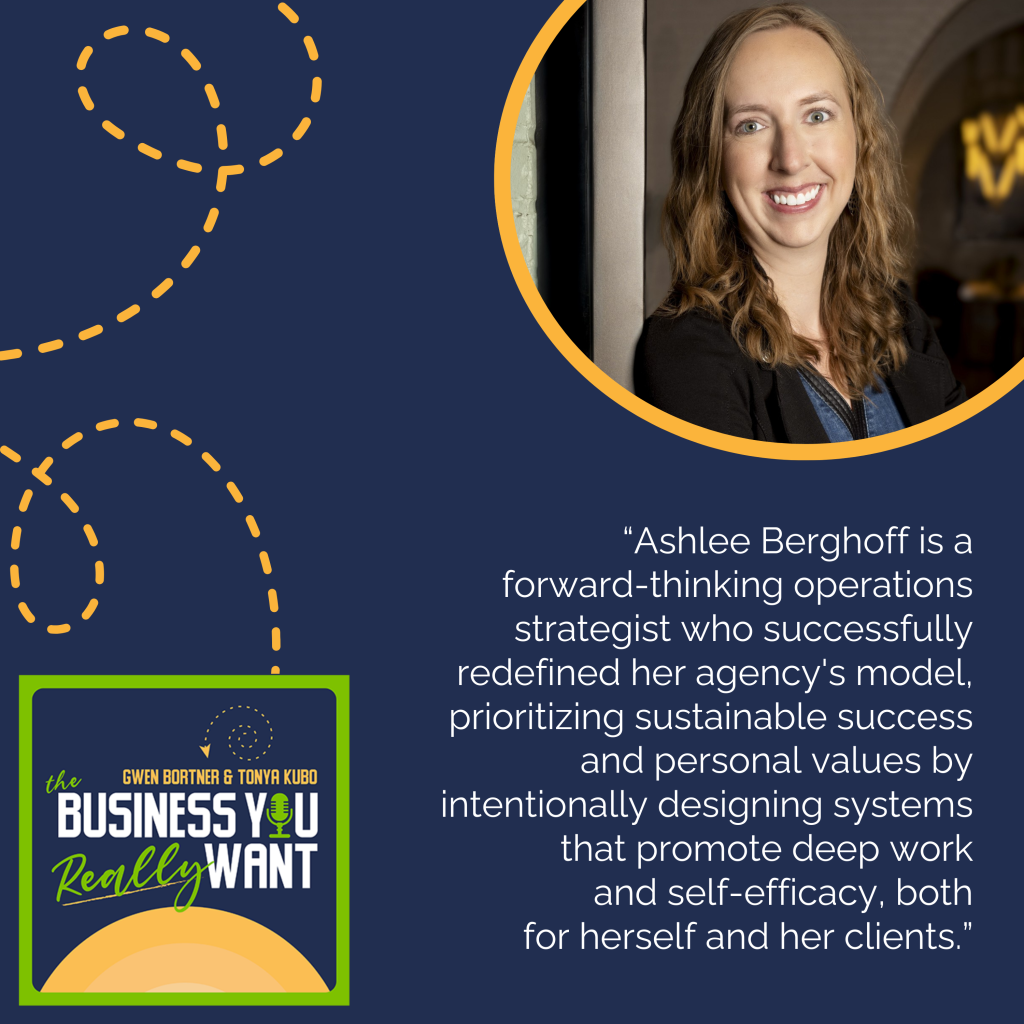
 Ashlee Berghoff is an MBA and systems strategist who helps event-based businesses scale to 7 figures through her program, Smooth Operator. After building a successful operations agency supporting over 100 entrepreneurs, Ashlee is now redesigning her own business model to better align with her original goals of freedom and family time — proving that even successful consultants need to evolve how they achieve their results.
About Your Hosts
Gwen Bortner has spent four decades advising executives and entrepreneurs in 45+ industries. She helps women succeed in business without sacrificing happiness by identifying their true desires and aligning their business functions. She spots overlooked bottlenecks and crafts efficient plans toward sustainable success that center your values and priorities. Known for her unique approach to problem-solving and accountability through the G.E.A.R.S. framework, Gwen empowers clients to achieve their definition of success without sacrificing what matters most.
Tonya Kubo is a marketing strategist and community builder who helps entrepreneurs build thriving online communities. As co-host of The Business You Really Want and Chief Marketing and Operations Officer (CMOO) at Everyday Effectiveness, she keeps conversations on track and ensures complex business concepts are accessible to everyone. A master facilitator with 18+ years of experience in online community building, Tonya takes a people-first approach to marketing and centers the human experience in all she does.
