Is the relentless pressure to scale up suffocating your entrepreneurial spirit? Gwen Bortner and Tonya Kubo challenge the “bigger is better” narrative, diving deep into why strategically staying small might be your greatest competitive advantage. In this episode, they dismantle the scale-or-die myth, exploring how limiting your business size can lead to premium pricing, unparalleled quality, and the elusive work-life balance you crave. They unpack the hidden costs of growth, the power of boutique businesses, and actionable ways to boost profitability without expanding. If you’re questioning the scaling script and seeking a more sustainable path, this episode is your permission slip to redefine success on your own terms.
—
Watch the episode here
Listen to the podcast here
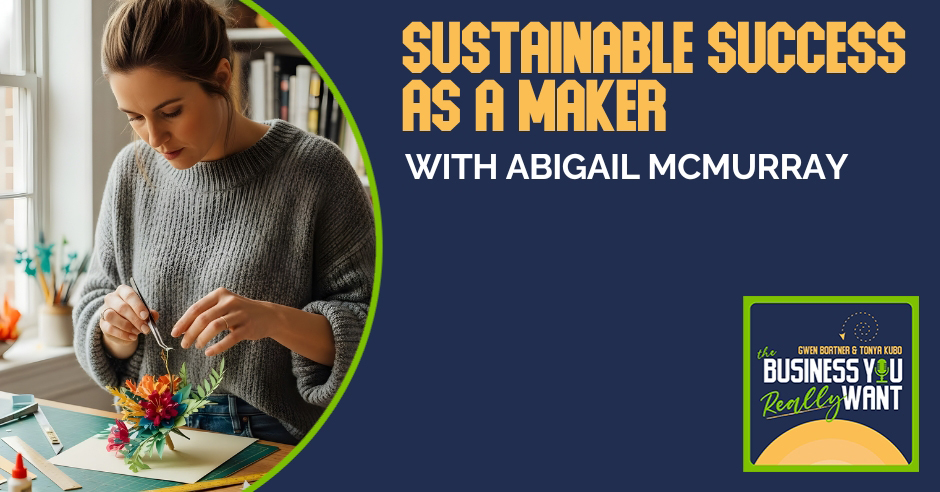
Sustainable Success As A Maker With Abigail McMurray
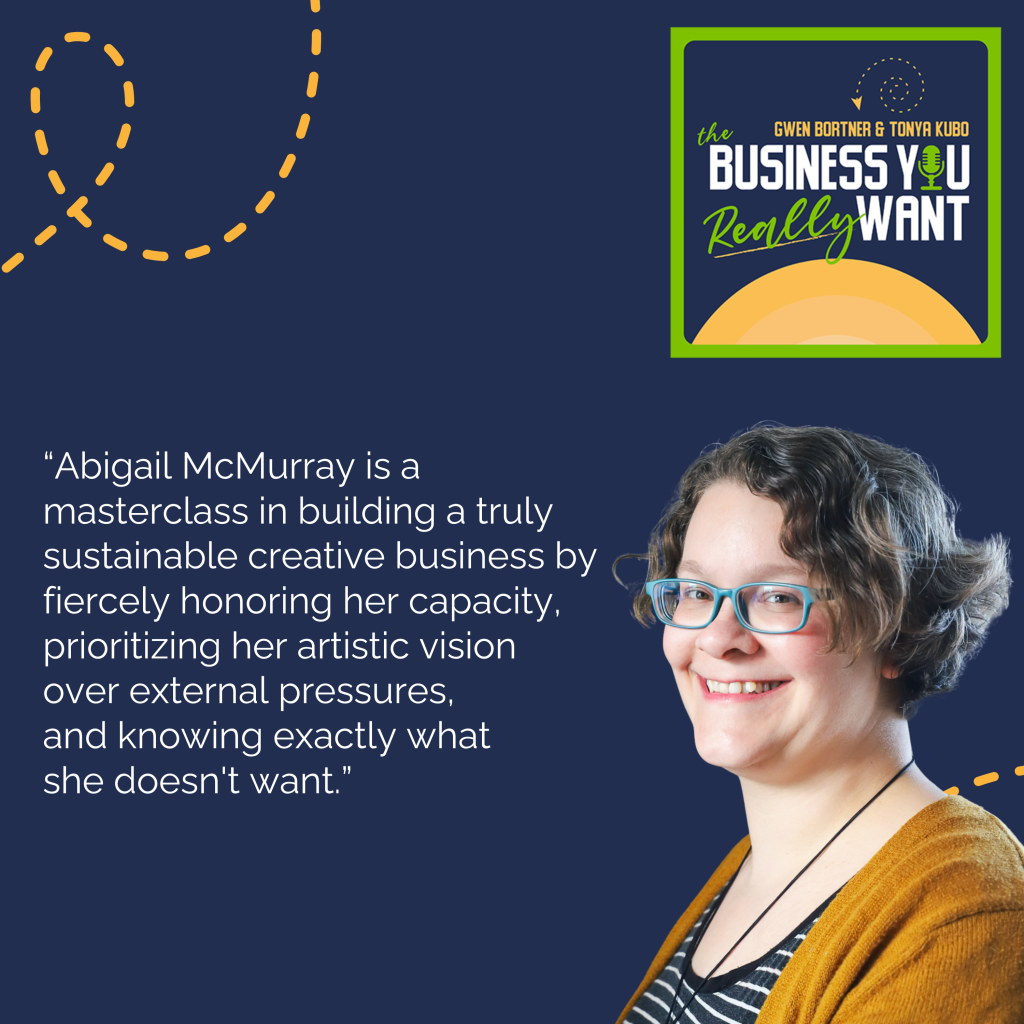
This episode is part of my What It Really Takes series, conversations with clients who are building businesses that honor their values, their capacity, and their creative energy. In this interview, I’m talking with paper artist Abigail McMurray. She is the founder and owner of YEIOU Paper Objects. Abigail has built this creative business that not only reflects her artistic vision but also supports the kind of life she actually wants to live.
If you’ve ever wondered what it looks like to grow a sustainable business as a maker, balancing the online sales, in-person events, and your own creative rhythm, Abigail’s story is a masterclass in simplifying, focusing, and thriving without having to burn out. If you like what you hear and want to talk more about it, book a call at EverydayEffectiveness.com/Clarity. Let’s get started.
I am so excited that you are here, Abigail. Ironically, it was very funny because at the end of my live with Nicole, I was talking about you and Hanna Lisa seeing each other in Germany. I’m not quite aware in my mind that you were the next one. I knew we were doing a live, but I didn’t realize you were the next one. It was like, “This is perfect timing. The person that we were talking about is actually who we’re talking with today.” Let me officially introduce you. I am super excited to have you and your willingness to be on our show that we’re doing as part of the celebration of our one year of Tonya and me doing this show together.
Exploring Abigail’s Work As A Paper Artist
We’re talking about what makes success sustainable and what it takes because The Business You Really Want is our show name. It is about not just creating the business that everyone says you’re supposed to have, but the business that is the thing that you want. I am super excited, Abigail, to have you on. I want to start with a very traditional interview question. Let’s be honest. Talking about your business, tell us about what you do, who you serve, and what it looks like when we first started working together, coming up close to three years.
I looked it up. I don’t remember, early ‘20s.
Tell us about your business. Tell us what you do and who you serve. Tell us about what it’s like for us to start working together.
I’m a paper artist. I make things out of paper. In the eleven years I’ve been in business, that has changed. I’m making things that celebrate place and home. I make map art. I make public transit vehicles and maps. I have also started working with some collage and inspirational quotes about coming home to yourself, and not just home as a geographical place. I’ve never been great at answering questions about who my audience is. That’s something I’m working on. I make pieces for people locally here. A lot of my work emphasizes the Boston area public transit locally to here. I also make custom maps of anywhere in the world for people who love a place and want to celebrate it in a unique way as wall art.
I would say part of your audience is people who appreciate original art and/or have a tight association with a place.
I like family vacation destinations or the place you’re moving to or from. In the Boston area, a lot of people are here for important seasons of life, like undergrad or grad school, or they’re here until they start a family, and then they go somewhere else. They want to remember the times here that were so dynamic.
Before we got on, I made you grab some of your artwork, because it’s one of those things that you describe, and it’s like, “Huh?” You see it, and you go, “It’s so cool.” At least that’s what I have done. This is one of your places. I hired you to do a similar type of thing for one of our friends who has this beautiful summer home on a lake that’s a private lake. I haven’t given you this feedback, but they were like, “This is the coolest gift.” We called them at the last minute and said, “Can we come in and spend the weekend?” They were like, “Yes, sure.” That was our thank-you gift. They thought it was the coolest thing ever. It was amazing.
It’s cut paper. This one has pom poms inside. Usually, it’s a color in the background, but I make these for anywhere in the world. For public transit, the local system here in the Boston area is called the T. I have this system map that I’ve made out of layers of paper.
I love that. It’s very cool. There is the newest thing you’re doing that I happen to know Tonya, who is my co-host, thinks is the best thing ever. As soon as she saw it, she was like, “Gwen, I want this.” I also think it’s cool.
There’s a little bit of glare here, but the letters are 3D, and the background is collage. I’m making these with a few different phrases and colors. I have been exploring some new ideas here.
I love the matting. The framing of it is also multi-dimensional. It’s not just a single dimension, even though it’s only in one color, which is super cool. The other thing, which, as you said, you don’t have because they’re custom-made, and when they’re done, they leave, is your house portraits. They are flipping amazing, the three-dimensional nature of them and all of the pieces. When I first saw it, it was like, “I didn’t even know you could do that with paper.”
They’re also the reason I started working with you, because I got some press in 2019 and 2020 and was head down, cutting and gluing tiny pieces of paper for two years. I was beyond burnt out. When I found you, and you were like, “Maybe there’s a way out of this,” I was like, “Please tell me. I’ll sign up.”
One of the things that’s very different between you and the work that I do with Nicole is that Nicole and I have been working as a private one-on-one client. You and I have been working together using our Weekly Course of Action process and our Quarterly Tune-up process exclusively. It’s going to be an interesting conversation to talk. It’s like night and day. It’s the kind of two extremes that we have of the product service offering. Nicole and I are talking every week. You and I actually don’t talk that much, occasionally, but we’re still communicating.
Those conversations we’ve had have been so meaningful that I run with those conversations for six months or a year. That has been amazing.
It depends on who you are, what you’re doing, and what you’re trying to do. There are lots of differences between what you do and what Nicole does, but one of the other differences is that Nicole is very much about growing her business substantially in huge ways. That is not on your radar at all. Part of it is, I totally support that. I support Nicole wanting to grow fast, but I’m also completely cool with you saying, “No, I don’t want this to be a big giant business where I’ve got five or six paper cutters and gluers and people working for me trying to get these things out.”
Talk a little bit about that decision for yourself and how that feels, because it’s one of the contrary things that we don’t allow ourselves to do to say, “No, this is the business that I really want.” You’ve got a pretty clear idea of what the business is that you want. Maybe not all the details, but conceptually, at a high level. Talk about that.
I have a stronger sense of the business I don’t want.
I love that. Talk about that.
You say having a team of five or six people, and that’s my nightmare. I am the person who loves to sit here and glue paper. It’s not the same thing every day for two years. The idea of managing a team is a whole different job. That’s not something I’m interested in. Part of the reason that you talk to Nicole so much more frequently is that she has the momentum of having a staff, having a team of people, and I’m two hands.
They’re two talented hands, but they are, as you say, only two hands.
Sometimes, I wish there were more, but not enough to manage other people.
Identifying What You Really Want To Do
I love that you say that, that you absolutely know what you don’t want. A lot of times, it is easier to figure out what we do want by actually focusing on what we don’t want. What we do want is such an unlimited possibility that it can be overwhelming, but saying, “I know I don’t want this. I know I don’t want that. I know I don’t want the other thing.” Along that line, how have you been able to both keep your product narrow and pivot and change over time? As you said early on, when you first started this business, you were doing very different things than you’re doing now.
Even when we started working together, you’re doing different things than when we started working together. At the same point, I don’t feel like they’re these massively different things where I don’t know how to put them in a bucket together. They totally make sense to me from a bucket standpoint. Talk about that transition, where you’ve gone from this thing to the next thing, and how you think through those transitions.
It comes back to knowing what I don’t want. If somebody tells me something I should do, have to do, or whatever, I have a pretty strong “No, I’ll do what I want” part. I started by making flat-pack gift boxes. Those evolved into craft kits. I added cards and some stickers and experimented with things, but with things that I was excited to experiment with. Maybe they started with, “What have you made?” “Cards.” It took me in my own time to go from that idea to a real thing. I’ve tried not to rush unless I’m excited about something.
That makes sense. How did you get to house portraits?
I was making these little craft kit flat-pack projects. I started making them house-shaped because there was a tiny house festival in the nearby town, and they were looking for vendors. I was like, “If I’m vending at a tiny house festival, I have to have a tiny house.” These were popular, more so than my more geometric things I was making at the time. I started making these as a set of three different colors and styles of houses. There were tall ones, fat ones, and different designs. People started asking for them to look like real houses. I could do that to some extent with this simple form.
Somebody asked for one as a keepsake, as a gift to someone, and backed up. I was like, “If this is a thing that’s special, precious, and you want to keep for a long time, this is faded, dented, and stuff, so it needs to be behind glass. It needs to be in a frame.” I did it for them. This is for a friend. A few months later, I had some more time and space and was thinking about that project again. I was like, “I wonder if other people would like this.” I made one of my own house. I posted it on Instagram. People were excited about it. It organically became more of a thing from there. All of a sudden, that’s all I was doing for two years.
It’s a very unique item, for sure. Depending on who we are and what our story is, sometimes our house or a place like that has deep meaning. For some of us, it doesn’t, which I get as well. I remember one of our Quarterly Tune-Ups, one of the other participants heard about you and said, “I’ve got to get this gift for my friend because he introduced himself as I’m so and so.” It was one of the boroughs in New York. I can’t remember which one it was. Brooklyn, I think.
How And Where Abigail Sells Her Products
Even though he’s living in California, “I’m so and so. I’m from Brooklyn.” It was his thing. I think even before we were done, she’s like, “I’m ordering this,” because obviously, that meant a ton to him. I remember talking to her later. “He loved it. He thought it was the greatest gift ever.” Where do you sell all of your products? You sell your products in a variety of channels and ways. Talk a little bit about how you make those choices.
I have a website. I also don’t advertise it, but I still have some products on Etsy. If people find them, that’s great. I have wholesale agreements with a couple of local shops here in the Boston area. I also do events in the local area, but maybe regional at different times, like a street festival where I set up a tent, bring all my work, and sell it on the street.
How do you figure out which of those things go where, why, and how? That’s a big deal.
It’s pretty organic. The website is there. I know that gift-giving season is in the spring and summer. At the end of the year, I’m likely to get a little bit more activity on the website. There’s the event season in the Boston area. There are a lot of outdoor big summer art markets. It is in May through June or July. There’s the holiday season, October, November, and December. I have been doing this for long enough that I can prepare for things and anticipate a little bit, or hope.
The one thing I learned when I was doing vendor stuff years ago was that you can never anticipate the customer. Whatever the thing is you have, you’re going to have the wrong thing. The thing I bring a lot of is what they don’t want. The thing I don’t bring a lot of is what they do want. If the next time I do exactly the opposite, it’s exactly the opposite. There is no winning that game.
Every once in a while, I guess right. It feels so good.
Every once in a while, you perfectly meet the product demands of your customers, and it feels great. Share on XIt’s like, “All the stars aligned.” You do have to get over that, “I’m bad for not knowing,” because you just can’t.
In the early days, there was a specific show. I remember it was right before Valentine’s Day. It’s like, “People are going to expect Valentine’s Day.” I stayed up until 3:00 AM, coming up with new Valentine’s Day-related products. There was a blizzard that day. The only people who came to the show were to let their kids run around in the gym while they sipped coffee and stared off into the middle distance. I sold nothing, none of the stuff I’d stayed up late for. I was delirious because I’d gotten three hours of sleep.
You had no sleep.
Never again.
Balancing Over-Delivery And Staying In Your Zone Of Genius
That leads me to another question. How do you balance trying to overdeliver versus staying in your zone of genius when it comes to your products, staying creative, and doing all of those things?
I don’t know.
I’ve seen you pivot. As I said, you seem to pivot with intention.
I’m glad it seems that way.
I love that answer. It’s not that way, but I’m glad it seems that way.
I don’t know. Pivoting is the change that my business has been through. I’ve always been a little angsty on the inside. We’ve talked a lot about transitioning from being a small, handmade business. I used to think of myself as a product designer, to thinking of myself more as an artist making art. I’ve been fighting that tooth and nail for three or four years.
I remember our conversation about it. It was like, “I am not an artist.” It’s like, “That’s not true.”
I remember having this conversation with a friend. He was like, “I can’t make stuff that goes in frames on the wall. Who does that? Artists do that. That’s not me.” Even in art school, I resisted putting things in a frame on the wall. I was trying to make interactive sculptural pieces or something. To find myself here making things that go in a frame on the wall, even though they’re still 3D and very neat, that was a big emotional hurdle for sure.
I remember one of the other emotional hurdles that we talked about that I’ve now seen that you’re doing on a somewhat regular basis, not constantly. It is submitting to calls for art or for particular shows and things. I was one of the ones to first lay down the gauntlet and say, “Try one. try it.” What has that been like for you?
It has been good. I do appreciate that challenge from you. As I mentioned earlier, I’m rebellious. I don’t like being told what to do, but however you delivered it, I received it well. I made a piece this spring specifically for a local call for art, and it didn’t get in. I felt good about having made a thing specifically for it and figured out how to work that in with all the other things I’m doing. Putting it out there was great. It was like, “Not a thing, moving on.” That has been okay. My alma mater is doing its first graphic design alumni show. I made a piece in this series. It’s not juried. They’re accepting work from everyone who applies. I will send that off, and that’s exciting. It’s back in Illinois. I won’t see it in the gallery in person, but to know that it’ll be hanging there is pretty cool.
How To Keep Your Creative Well Full
That’s awesome. Let’s move a little bit back to the business side of things. One of the things that a lot of people are always surprised about is that I work with people like Nicole, who are very much focused on a corporate business kind of thing, but I also do a lot of work with artists who are really artists. They’re not just creatives. A lot of times, people are like, “I work with creatives.” A lot of people qualify as creatives, let’s be honest, but artists who really are doing art-type activities. I’ll say it’s stereotypical, but still, stereotypes often come out of truisms. Artists often struggle with the business side of things.
How do you manage that for yourself, being able to do the business side of stuff that needs to happen, but still be able to manage holding that space for the artistic creativity pieces of it? It’s because they are two different sides of the brain. You probably can talk about it way more than even I can. What have you done for that? How do you balance it? How does that work for you?
As I said, I resisted being an artist for a long time, maybe my whole life, but in business terms, I have eleven and a half years in. It has only been since we started working together in ‘22 or whatever that I realized the cause of a large part of my burnout problem with the house portraits. In Julia Cameron’s The Artist’s Way, there’s this metaphor of the creative well and the idea that you can draw from it, but you have to refill it. My well was just sand by the time we started working together.
You can draw from your creative well, but do not forget to refill it. Share on XFor me, figuring out what constitutes refilling that well, and how to make space for that, when I had 6, 7, or 8 years of habits of doing it the other way, not making space for that, has been the challenge for me. Right now, my strategy is to take some community education classes. They’re affordable. They’re in my neighborhood. They give me space to have a structure to leave work behind and go throw paint around or whatever. Also, these products are sneakily designed to give me the time to play around with the collage stuff, which is fun. Even if it’s on the deadline and for work, that process is still something that fills me up because it’s so new and different.
How did the Weekly Course of Action help you in that process? As we said, the first time you and I had a long conversation about the business was probably somewhere 6 to 12 months in. We probably had an initial meeting.
We had an initial call.
Beyond that. The time that I threw you on the gauntlet, that was more like six or twelve months in. When you said, “I’d like to have a one-on-one call with you,” we scheduled an hour. We made that happen. How did the Weekly Course of Action help you start refilling the well? How did that process work? A lot of people can’t possibly believe that an asynchronous, non-actual conversation thing could impact the business. You’ve stayed in for long enough to know that it must be helping because you continue to do it.
In my recollection, that initial conversation we had was that I asked for help figuring out how to fix my house portrait process so that it wasn’t killing me slowly. I raised my prices. You challenged me to do a few different things to fix these things that I was feeling stuck in, in addition to the burnout. Once I was able to climb out of that, I raised my prices. I found a better frame supplier to make them feel more valuable in the finish and did a few other things. I fired some clients who had been placed in order but never sent me photos. They were hanging out, rent-free.
You can’t create something if you don’t know what it looks like.
Once I had gotten back out onto level ground, you helped me figure out that I needed to fill the well before I could move forward. I’ve tried different things with the WCA. I’ve added it as a weekly goal to spend some time doing something creative. There was a season where, for a month or two, I would take an extra day off every week in the middle of the week to do whatever I felt like doing and not feel like I had to be at my desk answering emails or reacting to things.
I used the weekly format as a way to give myself that structure and that reminder that a Wednesday is a day that you’re not supposed to be sitting at your desk. Go read a book. Go for a walk. That was when I first started using the community ed courses as part of that structure because they are so accessible. That snowballed into this new line of products and everything. Healing back up to baseline, making space, and then figuring out what comes out of it has been my art.
Importance Of Flexibility In Achieving Sustainable Success
What has been one of the surprises for you of being doing the WCA and being part of the Quarterly Tune-Up? As I said, you were one of our very first people who came in as a Weekly Course of Action only person. I barely started offering it as a standalone item. I’ve been doing it for not quite a year with my clients. At some point, it occurred to me. We were talking about how these things pivot. It was like, “This is valuable in and of itself.” What has been surprising for you?
That external structure has been super valuable, having the quarterly framework, having the weekly check-in accountability, and that cadence of work life. As I said, I’ve been doing this for eleven years. Before this, time would just pass. That still happens. I’ve been working on relaunching my website for a year. Things still can get away from me, but I’m more aware of the fact that it has been that long and made conscious decisions about prioritizing different things in different seasons, because that’s the structure.
I’ve used that weekly document in so many different ways. I mentioned making space for creative play. I’ve used it as a way to give myself structure for looking at my finances, expenses, and income every week as a way to have that practice. I love that it is structured, but I can make it the structure that I need in that season. That flexibility is important to me.
Your Success Is Vastly Different With Other People’s Success
The flexibility is part of the secret for the whole thing. For a maker like yourself, a creative artist, who’s trying to do everything, because a lot of folks who are artist makers are often like you, they are the one-man band. They’re doing it all. What would you tell them about making a sustainable business?
It’s important to know what your priorities and your values are first. There are so many people on the internet and in real life who will tell you the secret to making $1 million or whatever. If you can hold on to your specific values and priorities, I’ve seen so many people and had so many conversations with other people starting businesses. They’re like, “How do I get my products into shops?” I’m like, “You make something that’s pretty labor-intensive one at a time. Why do you want to put your products in shops? Usually, wholesale is a manufactured product. Your margins are so much less. If you’re making it by hand, it’s hard to make to pay yourself anything if you’re wholesaling.”
“I’ve been doing markets for a while. That seems like the next step. That’s what everyone else is doing.” You can put your products in shops. The way to do it is to go ask the shopkeeper or whatever, but I encourage you to take a look at your costs and your time and make sure that this makes sense for you. Just because it makes sense for someone else doesn’t mean it makes sense for you.
There’s so much wisdom in what you said. The thing that so many people get caught in is that Susie over here has taken this path. It looks like Susie is super successful, so I probably should take Susie’s path.
If Susie wants to charge you money to tell you how to take their path, that means that Susie’s path is maybe not as lucrative as they’re telling you.
If someone wants to charge you money to tell you how to emulate their journey, their path may not be as lucrative as you think. Share on XI love that. Often, Susie only knows one path, and it may have been lucrative for her. One of my favorite sayings, and I don’t think I ever get to do it on a talking thing without saying, “Context matters,” because it does. Part of the reason it may work for Susie is that what she needs to be successful is not the same as what someone else needs to be successful. What is their definition of success? I love what you said about them wanting to charge you money to tell you how to do the same successful thing.
My bigger thing that I see a lot is that they do know how to tell you how to do it this one way. Especially when we’re talking about creatives, makers, and artists, there’s so much context in the art itself to say whether or not that particular path is going to work. Even if the art feels very similar, we still have the variable of the artists themselves, and how much time, thought, energy, and things go into this piece. For someone, it may be more like manufacturing, and someone else is like, “No, this takes all of my energy,” even though what looks like the finished product may be pretty similar. From a completely ignorant person like me, it’s like, “That’s a painting, and that’s a painting.” I don’t see the difference from that standpoint.
Setting Your Own Course For Achieving Success
There could be a lot of context in there that makes those two paintings, which are both the same size, have a whole different piece in there. There’s huge wisdom in what you said. Anything else that you want to share, as you were thinking about this? We prepped you, we gave you questions, and we haven’t quite gone through them in order because that’s not the way I work. You knew that coming in, so no one is shocked or surprised. Anything else that, as you were thinking about this, you were like, “One thing people need to know that has changed the way I’ve been able to work, that’s made my work more sustainable,” even if you’ve said it before?
In our conversation about context, I want to mention that part of that context calculation is your real life, too. I don’t have kids. My husband also works from home, so our life context is more flexible than other people’s. When I do hit that busy season, I can pull strings to have someone else cook dinner and have someone else do the laundry in a way that not everyone can. The business that I design and the ways that I design it to be flexible are so different from those of other people.
I love that you shared that, because a key piece in understanding what success looks like for people is also not only what success looks like, but what my reality is. There are certain things that you can’t undo, at least not easily, and that you have to take into consideration. One of my clients has a brand-new baby. You can’t not deal with the fact that you have a brand-new baby. You have a brand-new baby. They need to be fed. They need all the things. It is very different from another client who’s dealing with high school age kids, which is a whole different set of issues and rules, to folks who have kids out of the house, to folks like you and me who don’t have kids at all.
We aren’t dealing with little kids, old kids, young kids, or grandkids. We’re not dealing with any of those things. Being aware of what our reality is as we’re defining that success is also super important, and knowing where you have the flexibility. Where do you not have the flexibility? It is not to try and create something that probably can’t be created in a reasonable way, unless you’re willing to do the unreasonable things that it may take.
As I said, I’ve had seasons where I was up until 3:00 AM, which I could do because I wasn’t caring for small children, but ultimately wasn’t the lifestyle that I wanted to have. I’ve been working on ways to make different decisions and keep work contained to more traditional working hours.
Episode Summary And Major Takeaways
I love that. To do a quick summary, as always, context matters. I love that that came up. When we’re starting to define our version of success, also knowing what we don’t want was an insightful thing. Often, that’s an easier place to start. What I know I don’t want, what absolutely gives me the heebie-jeebies, the things that are so energy draining when I even say the words coming out of my mouth, is huge. It is being willing to adjust and pivot over time, and not necessarily being too worried about it being super intentional.
As I said, from my standpoint, as a relatively knowledgeable outside observer, it looked way more intentional than what it may have been, but you were able to do it because you were doing it based on what made sense internally for you. It wasn’t being driven by somebody else saying, “You should do this.” It was like, “This is an interesting idea. We can keep making the shifts.” Quite honestly, that was the same reason that we’re working together. I made one of those same shifts. It’s like, “We could probably offer this as a standalone product.”
Here we are. I always love having conversations with you because you are a delight. I love the product that you create, as you know, because, as I said, I give it to friends. I have also given it as a client gift on a regular basis because it is a fabulous piece. If you haven’t had a chance, go to Abigail’s website at www.YEIOU.com and check out her art. It’s amazing. It’s super cool. Abigail, thank you for being here. I very much appreciate it.
Thank you so much.
As a reminder, we’ve got one more scheduled of these sustainable success sessions with our existing clients, and talking about their road to sustainable success. We’re going to be meeting with Ashlee Berghoff, who’s also an ops person. We’re on the whole gamut of the types of folks that we work with. We’re going to be meeting with her at 12:15, Pacific, in September. I got to double-check the date. September 2nd. She and I also have great conversations. We’d not do this with someone we didn’t have a great conversation with. It’ll be a fabulous conversation as well. Thank you again, Abigail. I very much appreciate it.
Mentioned in This Episode
- YEIOU Paper Objects
- 30-Minute Clarity Call with Gwen Bortner
- Abigail McMurray on LinkedIn
- The Artist’s Way
About Abigail McMurray
 Abigail McMurry is the paper artist behind YEIOU Paper Objects, which she launched in 2014 at a local arts fair in Somerville, MA. Since 2018, she’s focused primarily on creating custom three-dimensional paper house portraits — framed keepsake sculptures that have been featured on NBC, Apartment Therapy, and NBC’s “Making It.”
Working from her home studio outside Boston with her feline assistant Bash, Abigail has built a sustainable creative business by narrowing her focus, balancing online sales with the same in-person craft fair she’s attended since Day 1, and staying committed to both her artistic vision and her values.
About Your Hosts
Gwen Bortner has spent four decades advising executives and entrepreneurs in 45+ industries. She helps women succeed in business without sacrificing happiness by identifying their true desires and aligning their business functions. She spots overlooked bottlenecks and crafts efficient plans toward sustainable success that center your values and priorities. Known for her unique approach to problem-solving and accountability through the G.E.A.R.S. framework, Gwen empowers clients to achieve their definition of success without sacrificing what matters most.
Tonya Kubo is a marketing strategist and community builder who helps entrepreneurs build thriving online communities. As co-host of The Business You Really Want and Chief Marketing and Operations Officer (CMOO) at Everyday Effectiveness, she keeps conversations on track and ensures complex business concepts are accessible to everyone. A master facilitator with 18+ years of experience in online community building, Tonya takes a people-first approach to marketing and centers the human experience in all she does.
