Is the relentless pressure to scale up suffocating your entrepreneurial spirit? Gwen Bortner and Tonya Kubo challenge the “bigger is better” narrative, diving deep into why strategically staying small might be your greatest competitive advantage. In this episode, they dismantle the scale-or-die myth, exploring how limiting your business size can lead to premium pricing, unparalleled quality, and the elusive work-life balance you crave. They unpack the hidden costs of growth, the power of boutique businesses, and actionable ways to boost profitability without expanding. If you’re questioning the scaling script and seeking a more sustainable path, this episode is your permission slip to redefine success on your own terms.
—
Watch the episode here
Listen to the podcast here
Sustainable Success As Podcasters With Tonya Kubo
This episode kicks off my What It Really Takes series, conversations with people who built businesses that align with their values, their capacity, and the life they actually want. We’re starting with something a little bit different. I’m joined by Tonya Kubo, my co-host, as you know, on The Business You Really Want, to talk about what it’s taken to build and sustain this show in a way that matches what we teach.
From defining success beyond the downloads to building systems that don’t burn us out, this is a look behind the curtain at how we keep this show consistent, enjoyable, and aligned still while running our own businesses. If you like what you read, let’s chat. You can book a call at EverydayEffectiveness.com/Clarity. Let’s get into it.
—
I’m excited to be here with one of my very favorite people, Tonya Kubo. In case you don’t know who I am, I am Gwen Bortner. I’m the founder of Everyday Effectiveness. We’re doing something a little different. Tonya and I co-host a show together. We’re going to interview ourselves. Normally, Tonya is the interviewer. In this episode, I am going to be the interviewer. What we’re going to talk about is The Business You Really Want show has passed one year.
Planning Everything Ahead Of Time
We’ve been successful in doing it without burning out. This is our own behind-the-scenes reality check on what sustainable success actually looks like when you practice what you preach. I’m going to start with a question to you, Tonya, because usually, you start with a question. What do you think has made our show sustainable?
I’m going to volley that one right back to you when I’m done. The first thing that has allowed us to be doing this for a whole year is that we actually spent time on the front end planning it. We didn’t plan for everything to go perfectly. We did some worst-case scenarios. We talked a lot about our schedules because you do a lot more traveling than I do. I do a fair amount of travel as well. My travel times tend not to be the same as yours. It’s not like we’re ever out of the office at the same time.
That’s good, but it probably is bad sometimes as well.
It makes it tough to record when you’re not able to get online. One of the things we did was look at how far ahead we were going to have to be recording for us to be able to consistently drop episodes every single week, if there was a month where you were gone three out of four weeks, and there was a month where I was gone several weeks. That’s the first thing. It was the planning ahead, but not planning as if everything was going to go 100% perfectly.
Part of that sustainability is the same thing, from my perspective. We do try to get ahead of the schedule as much as reasonably possible whenever we can. I had a cold. Because I had a cold, I didn’t want to be recording with my deeper voice. I already have a pretty deep voice as it is. We were able to cancel our recording without panicking, because it’s like, “Are we going to have enough episodes?” We’re usually about four episodes ahead, but sometimes, we get up to as many as six or more.
I try to keep a 6 to 8 episodes ahead, so that in a big travel period, we never fall farther than four weeks ahead.
Planning for being ahead seems like such an obvious thing when someone says it, like we’re saying now, but it’s harder to do than people think it is. It is about being focused on it and being aware of it. Not very many weeks ago, I’m like, “Are we far enough ahead?” You’re like, “We’re three weeks ahead.” We had started getting tight because of various travel things and some unexpected cancellations that we had to make.
Part of it is planning enough time for when things don’t go well. We had one where partway through, the technology just went. We had almost an entire episode recorded. We realized, “We can’t recover this episode. We’re going to have to completely re-record this episode.” If we were on a super-tight schedule, that would have put a wrench into the whole works.
Always plan ahead of time so you know what to do when things do not go well. Share on XNever Running Out Of Topics To Talk About
What do you think has contributed to the sustainability?
What we were talking about is a huge one. The other is that we picked our topic broadly enough that we didn’t run out of things to say, and we don’t foresee running out of things to say. When we talk about The Business You Really Want, we’re talking about all of the aspects of business. Between the two of us, we have a pretty good understanding and knowledge of most aspects of business. We can talk about a lot of those things over time.
We can not get so deep into a particular subject. It’s like, “We’ve said that fifteen times before.” There are things that we will repeat, and there are things that come back up, but they generally come at it from a different angle each time. One of the sustainability things is the variety of topics that we talk about, although it is always around “Are you designing and building the business that you really want, not the one that everyone is telling you that you’re supposed to have?”
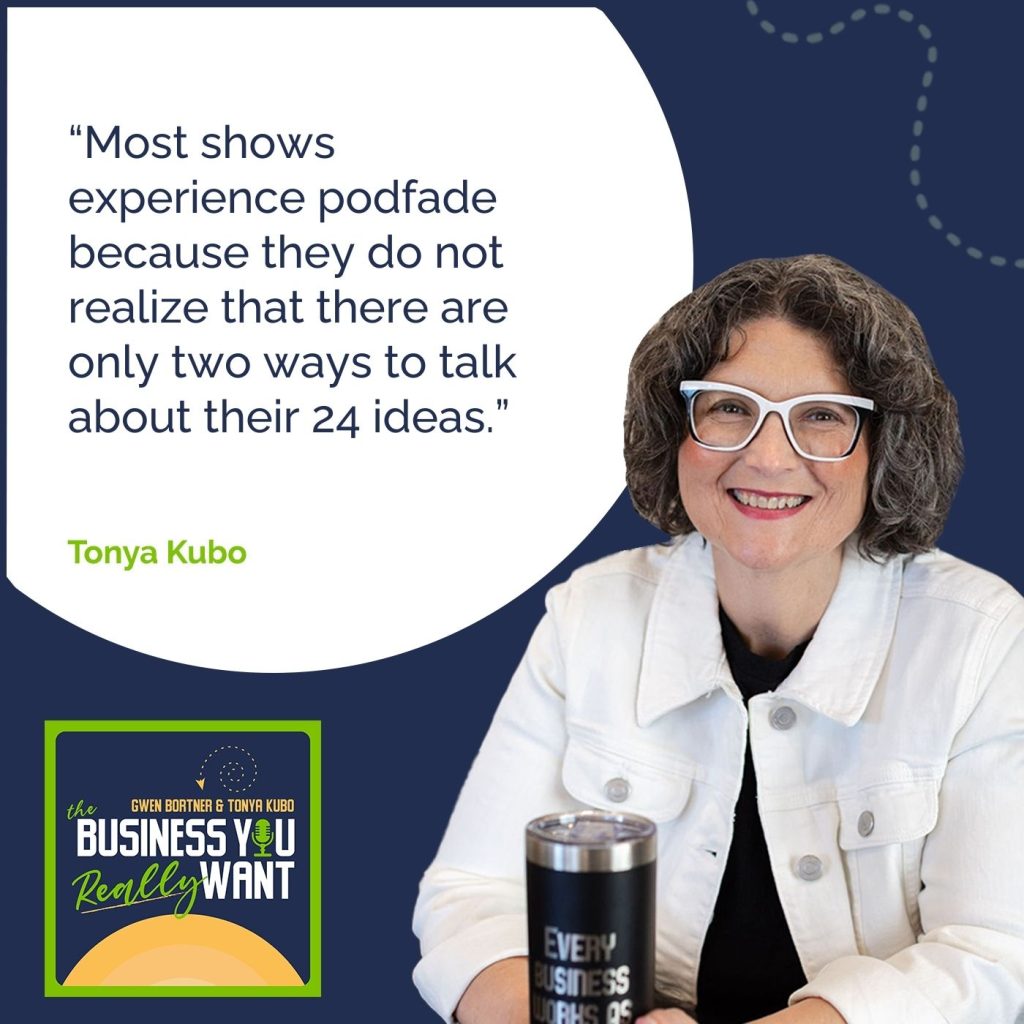
That is such a good point because I can think of how often people paint themselves into a corner. We’re told, “Niche down. Be super specific. Get deep expertise that you want to showcase.” That’s what causes podfade in a lot of instances. Somebody sits down, they brainstorm, and they’ve got 24 ideas, but they don’t realize that there are only two ways to talk about their 24 ideas, unless they want to go to 48 episodes and then start back at one.
I have one more thing that has helped it be sustainable. We’ve had those instances where I’ve been like, “I feel like I’ve said all that I can say,” and you’ve said, “Actually, we haven’t talked about this.” That has been helpful. The other thing is that two of us have helped with the sustainability. We get sick of talking. I get sick of myself. I get sick of the ideas that are always in my head. I’m like, “Nobody cares.” You’re like, “Actually, Tonya, that question has come up five times this week with my clients. Maybe they don’t care, but they should. This is how we can talk about it. That isn’t how we talked about it before.” That outside perspective is helpful.
Three Major Challenges Of Having Podcast Guests
Another thing that strikes me in the sustainability piece is that we don’t have guests. It’s us. It’s not just me. It’s not just you, like you said. There’s more to be said on this particular topic. We made a very strategic choice not to bring guests on when most people would have said that was a bad move. We’re like, “No, this is the way that we’re going to do it. We’re going to do it as an interview show, per se, but you are the interviewer every time.” Although I officially own it, I am the host, and you are the co-host. You’re the one interviewing me.
It’s not just me being a talking head by myself. Not that that’s wrong, but I find most people who do individual shows also either intersperse guests in, or at some point, you can tell they’re tired of talking about the things that they’re talking about. I do think ours is more of a conversation every time. You take some time to think about it and help script the general flow, but we don’t script very much. It really is a conversation. That makes it more sustainable as well, because we don’t feel like we’re being trapped into saying the same thing again and again, and we can allow it to go. There have been more than once where we’ve got on with pretty much no script at all. We’ve had an idea, and you’re like, “It’s a good idea. Let’s record that right now.” “Okay, here we go.”
Those are my favorites, even though they are always unpredictable. This could go well or not well.
Also, our long-term relationship makes a difference. You can talk more about that as someone who has been trained as an interviewer in your prior career. Our relationship makes a huge difference.
I would agree. The relationship piece makes a big difference because I know which boundaries I can push. I don’t have to worry about something like shutting you down entirely. We’re open. We’ve also had this relationship on the microphone that has built over time. Anybody who tunes in to say episode 2, and then tunes in to episode 52, will see that we are much more comfortable with each other and going back and forth. I will say episode 1 was very much like this. I ask a question. Gwen, you answer the question. I ask a question.
The Advantage Of Having A Co-Hosted Podcast
It’s funny because the audience never says that. They are like, “I love that episode. I love this episode.” I tuned in to episodes 1 through 3 because I feel like episode 4 is when we got our rhythm. I’m like, “I’m amazed that they came back for more.” I want to touch on what you said about interviews because I do think people get pitched on the interview format for a few reasons. One is that they’re told that they’re easier. All you have to do is book guests. You ask the guest questions. You can ask the same questions every time, but it’s still a different show because every guest is going to give you different answers.
Interview shows are painted as being easier than solo shows. I don’t think people think about consistently co-hosted shows. That’s something that people are now starting to see as an option. The other thing you hear about interview shows is that people act like they’re easier to grow because your guest is going to promote your episode. You’re going to get in front of new people all the time. This isn’t the only show I co-host. I’m getting ready to launch my own show, which is an interview format.
What people don’t realize is that number one, it is hard to chase down guests. You think it’s hard for you and me to find time to get on the mic. We know each other’s schedules inside and out. Try getting on the mic with a bunch of different strangers from all over the globe. That can be very difficult. There’s a lot of chasing people down and a lot of follow-up that’s required.
Second, you can’t control how your guest markets the episode. Maybe they don’t have time. Maybe they have a full marketing calendar, and they’ll get around to it 30 days after the episode drops. It’s always a bonus when your guest promotes the show, but you can’t bank on it. The third thing is, let’s be blunt, people guest on shows to grow their business. They are not showing up as a guest on your show to grow your business. I have had amazing interviews, but it always feels like there’s this dance. Sometimes, it’s almost like the guest is jockeying for more attention than the host.
You cannot control how a podcast guest markets your episodes. It is a bonus if they promote your show, but you cannot really bank on it. Share on XThat’s uncomfortable to tune into. You never know whether this guest is going to understand that I have an audience who I owe a valuable show to, or they are going to think that this is their platform to speak their stuff. I had that experience. I used to do interview livestreams. I had somebody. Every time I asked them a question, they would say, “I’m not going to give you that answer. If you bought my program, you would know.” I’m like, “How do I go anywhere if your answer to every question is you have to buy my program to find the answer?” That’s not fun for me. It’s also trash for my viewers.
Interviews are not the end-all be-all. What I love about our co-hosted format is that everybody thinks I’m the interviewer, and I’m in charge, but no, I get to show up as the advocate for our audience. I get to go, “Gwen, I know what you mean,” but the average audience is going to be like, “That sounds too stinking easy.” Because we’re comfortable with each other, I can push on things that if we were strangers, you wouldn’t know me well enough to know that I had good intentions behind my pushing. I wouldn’t necessarily know that it was safe to do that with you.
I was going to say you wouldn’t even probably start to go there because it would feel awkward.
I feel mean.
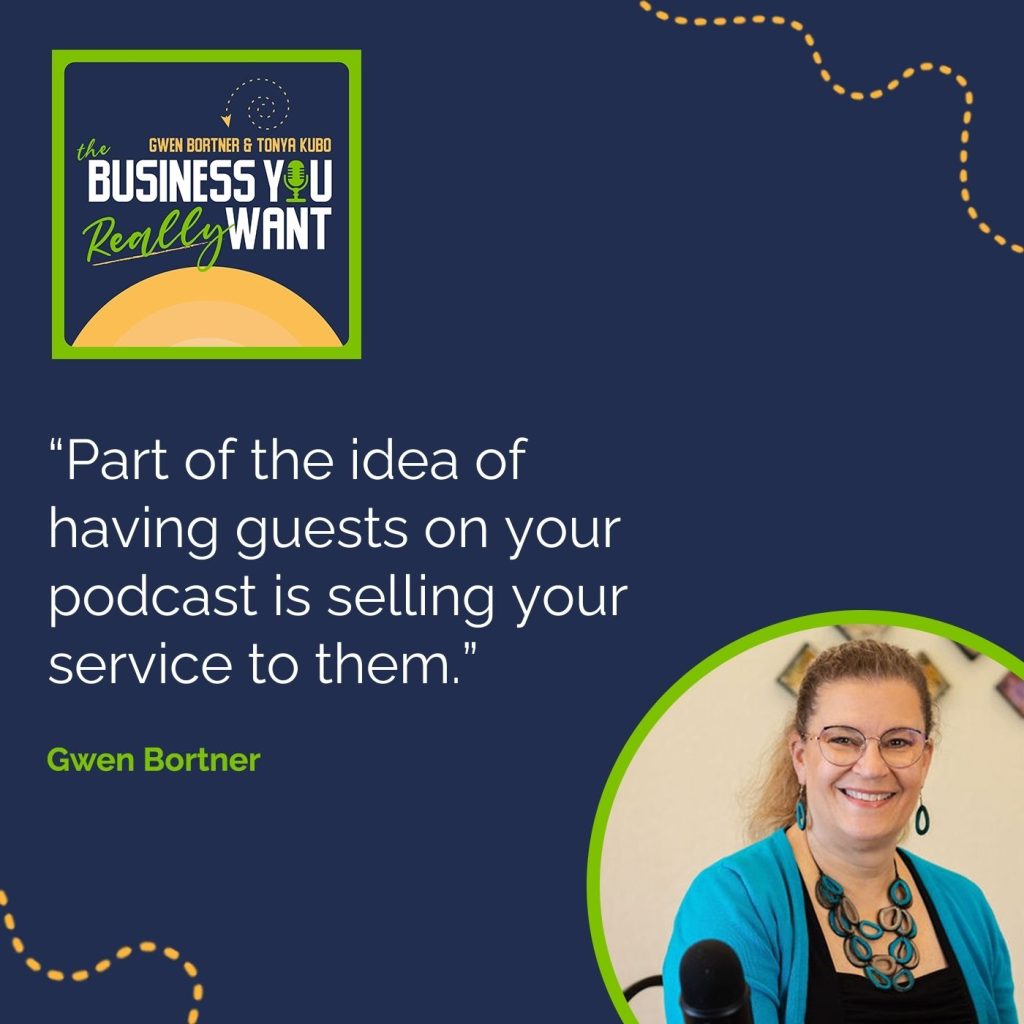
We’re just weird. That seems like a weird thing to say. No, that makes a huge difference. I want to plus-one the whole idea of chasing down guests is way harder than it sounds, based on a lot of people I’ve talked to that have podcasts that are guest-driven. You’re starting one and are in the midst of all of that as well. You already knew that going in. This was not news to you because you’ve been on the other side of it. It sounds like it’s fun because you can say, “I’ve got all these people,” but it’s like, “Not really.” Way back when, this is me not knowing what I’m talking about, so you have to correct me. I also know that way back when, part of the idea of having guests on your show was that you were going to try and sell the guest your service.
That is a model that a lot of consultants use. They invite people whom they want to work with and use it to soft sell them, sometimes hard sell them. That’s also uncomfortable to listen to as a guest.
It was like, “No, I don’t want this to be a subtle or not-so-subtle sales tool in that way. I wanted this to be a marketing tool for people.” The thing that you said, which I loved, was that people need to understand what it sounds like to work with you because you say things differently. You talk about things differently. The only way they’re going to understand that is to hear you talk.
Back to why I don’t think a guest format would have worked, it is because you’re blunt. Part of the awesomeness of working with you is that you say things other people don’t say. You’re willing to ask hard questions and sit there silently with a kind look on your face, but still silently. You don’t get uncomfortable. You don’t jump to fill in the gap. On an interview show, people wouldn’t be able to see that about you. When they see the two of us together, they hear the real you, not the representative of Gwen. Anybody who ever gets on the call with you, whether it’s a networking call or a casual chat, talks to the same Gwen that they hear on the show every week.
Things That Could Not Have Been Possible A Year Ago
Let me ask you one last question. What do you think is possible as we move into year two that you probably didn’t think was possible when we started?
There’s actually a lot. Let me tell you the first thing that was never on my radar, which was that you and I would get invited as a duo to be guests on podcasts to talk about podcasting together, our strategy, and how we’re doing it. That happened on Megan Dougherty’s show. I meant to look up the exact name of her show. It was a fun one. It’s a total inside baseball conversation.
I know she has gotten a ton of comments on it because I think our insights together on the two halves of the equation presented a whole different point of view.
When we came into this, I came into this very much from the perspective of “I work for Gwen.” This is me showing how Gwen is awesome, but also helping people to understand that when you talk about The Business You Really Want, you’re talking about the business they want and not the business you want for them. A lot of us have worked with coaches who are shoving their idea of success down our throats. I knew that a lot of people say that, but not a lot of people do that. I wanted to demonstrate that. It never occurred to me that we would get invited to show both sides of the coin, and that that would be valuable to people. I’m not going to lie. I had a blast on Megan’s show. That was so much fun.
Part of it is because Megan is also a pro. Let’s give credit where credit is due.
She is awesome.
You’re right. That would have never occurred to me, either, at all. Part of me expected it to be as easy as it has been, and part of me didn’t expect it to be as easy as it has been. I’ll say the no-brainer-ness of continuing after a year is probably the thing that was a little surprising to me, not that we are continuing beyond here, but how obvious it was that that was absolutely what we would be doing.
I wasn’t sure we’d still like each other. I know that sounds harsh, but you know how there are people you like as friends, but you don’t necessarily want to do business with them? There are people whom you love doing business with, but you wouldn’t necessarily want to hang out with them socially. I thought there would be a point where we would be like, “This is a little too much togetherness.”
There are people you like as friends but do not necessarily want to do business with. Share on XThat could still come.
“I’m tired of you saying context matters,” but I’m still not tired of you saying context matters. I still think we have a different conversation every time we’re on the mic.
Episode Wrap-up And Closing Words
It’s because we both have a lot of value that we add as part of it. I would love to say it’s all me, but that would be a total lie. That’s not even close to true. It’s because we are co-hosts. We’re both adding value to the conversation. This has been a fun conversation. If you are interested in some more conversations, we have a few more scheduled in the upcoming weeks. These will be conversations with my clients so that they can talk about what it’s like to actually work with me and be on the other side of those long silences and hard questions, sometimes both.
Effective podcast co-hosts both add value to the conversation. Share on XOur next one is with one of my longest-term clients, not my very longest, but one who has been with me for a number of years now, Nicole Serena. She is an amazing consultant who, when she started with me, was running her business as her solo consulting firm. She now has a whole agency that she’s got running along with lots of other businesses, including Tonya’s dream business of owning a laundromat. We’ll probably get there as well. We’ll see. Nicole and I talk about lots of things. There’s no telling. Nicole is another person that I have become friends with over time. I know it will be a great conversation. I hope that you join us next episode.
Mentioned in This Episode
- 30-MInute Clarity Call with Gwen
- Everyday Effectiveness
- You Are Your Own Benchmark for Success with Gwen Bortner and Tonya Kubo
- Find Your Freaks Podcast
- Clutter Free Academy Podcast
About Your Hosts
Gwen Bortner has spent four decades advising executives and entrepreneurs in 45+ industries. She helps women succeed in business without sacrificing happiness by identifying their true desires and aligning their business functions. She spots overlooked bottlenecks and crafts efficient plans toward sustainable success that center your values and priorities. Known for her unique approach to problem-solving and accountability through the G.E.A.R.S. framework, Gwen empowers clients to achieve their definition of success without sacrificing what matters most.
Tonya Kubo is a marketing strategist and community builder who helps entrepreneurs build thriving online communities. As co-host of The Business You Really Want and Chief Marketing and Operations Officer (CMOO) at Everyday Effectiveness, she keeps conversations on track and ensures complex business concepts are accessible to everyone. A master facilitator with 18+ years of experience in online community building, Tonya takes a people-first approach to marketing and centers the human experience in all she does.
