
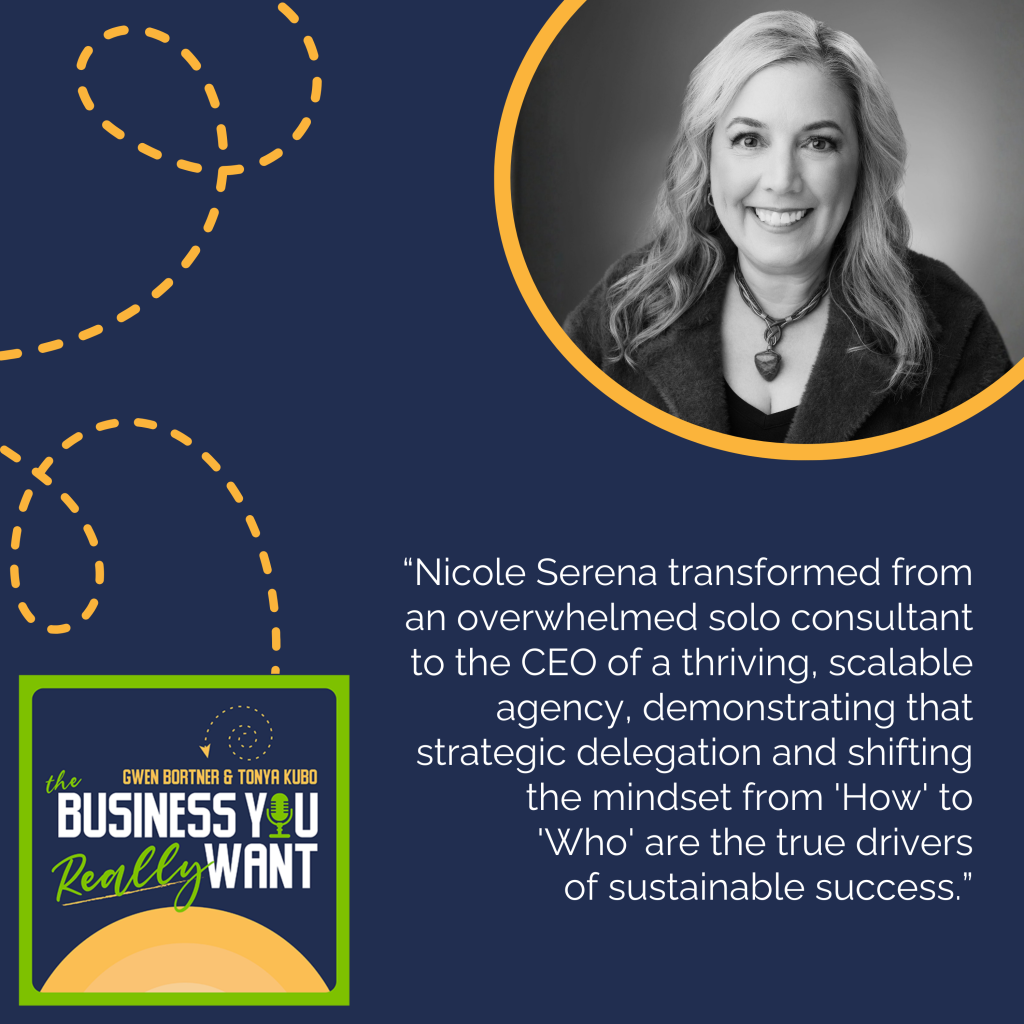
Consultant-turned-agency-owner Nicole Serena joins Gwen Bortner to talk about her journey from a one-woman consulting practice to leading a thriving healthcare operations agency. Nicole pulls back the curtain on the early days—juggling every client, deadline, and inbox herself—and how she knew she needed to make a change before something important broke.
She and Gwen walk through the pivotal decisions that allowed her to scale sustainably, including hiring her first consultant instead of a VA, shifting from doing everything herself to leading a team, and learning the art of transferring trust (even when it’s uncomfortable).
In this episode, you’ll learn:
- Why Nicole’s first hire wasn’t admin support—and how that changed everything
- How she manages rapid growth without burning out her team
- What “stability quarters” are and why they matter during fast scaling
- How quarterly planning and weekly accountability transformed her business
- The difference between being the expert and becoming the CEO
If you’re a consultant or service provider dreaming of building an agency—or even just wanting more breathing room—Nicole’s story offers a clear, honest look at what it really takes to scale sustainably.
If you want support creating your own version of sustainable success, let’s chat. (https://everydayeffectiveness.com/clarity)
Links and Mentions
Connect with Nicole (https://www.linkedin.com/in/nicole-serena-876a1913/)
—
Watch the episode here
Listen to the podcast here
Sustainable Success At Scale With Nicole Serena
From Solo Consultant To Agency CEO: Defining Your Own Success
Our episode is part of my What It Really Takes series, real conversations with clients who have built businesses that align with their vision of success, not someone else’s. This time, I am talking with my good friend and longtime client, Nicole Serena, who started as an independent consultant drowning in client work, and is now leading a thriving agency with a team handling most of the delivery.
Her transformation did not come from hustle. It came from redefining success, simplifying what was not serving her, and stepping fully into her leadership role as CEO. If you are stretched thin as a solo provider or trying to scale sustainably, this conversation will feel both refreshing and completely achievable. If you like what you hear and would like to talk a little bit more about it, let us chat. You can book a call at EverydayEffectiveness.com/Clarity. Let us jump in.
—
Welcome to what it really takes for sustainable success this time with Nicole Serena. I would love to tell you what Nicole is CEO of, but there are like 8,000 businesses that Nicole has. The overarching business is Waldron & Associates, but the primary business we are going to be talking about today is PSP Solutions. My name is Gwen Bordner. I am the CEO, founder, and owner of Everyday Effectiveness. Nicole and I have been working together for about five years now. I have actually lost track of working with her in her business.
We are going to talk about what it is like to be working with me and how we were able to work together for her to build a business that started out pretty much as a one-man band of Nicole doing it all, to a really successful agency that she has been able to build. Instead of me giving a big, long explanation of who you are, why don’t you tell us a little bit about what your business is like today, who you serve, what you do, and then we will do a little backwards in time. You can tell us about where we started when you and I first started working together.
Thanks, Gwen. I am excited to be here with you. Nicole Serena, I am the CEO. We will talk about PSP Solutions because that is where Gwen and I work together most of the time. What we do is we work within the healthcare industry, if we think of ourselves as patients, if you get prescribed a high-cost medication.
Let us say your insurance does not cover all of it. There are programs out there that help you manage the difficult navigation of private or public insurance, also covering some of that extra copay or deductible that can be thousands of dollars, as well as helping you figure out how to store this medication. If it is an injection, how do I give myself an injection, or how do I get someone to do it?
We work with the companies that design these programs. We help them when they get a little messy in the middle. We help right-size them when they get too expensive. That is our expertise that we work in. You are right. I started as a single consultant coming out of a 25-year corporate role. I saw a niche in the market for consulting. Now we have an agency, which is really exciting.
How many folks do you have working with you? How big is the team?
It right-sizes itself.
I know it expands and contracts as needed. How big has it been? How big is the biggest?
About fourteen.
Juggling Glass Balls: How To Recognize Your Scaling Breaking Point
It has grown significantly in a relatively short period of time. When we first started working together, I think overwhelm is probably an overused term right now, but I am thinking you were nearing overwhelm because you really were delivering all of the services, wearing all the hats, getting all the sales, doing all the things. What made you decide you needed to do something different? What was the reason you reached out? What was the reason you decided we should start working together?
Again, I use the analogy of juggling many balls. A lot of my team and people who work with me know that. I was juggling more balls than I had ever juggled. Some were plastic. Some were rubber and could bounce, and some were glass. I was getting too many in there, and I was really worried that an important one was going to drop and break. Starting as a fairly new consultant, building your reputation that way in an industry, people remember you long when you do not do something well.
I was really worried something was going to drop, and I was trying to manage so many things. It was getting to where I was worried that something important was not going to either hit a deadline or I was going to forget a meeting or something like that, or get double-booked because I was doing it all myself. You remember those days. I was filling every minute of the day and then some.
I was going to say, I have 24 hours, but somehow you were working like 26. I am not even quite sure.
Only three dimensions or something.
You were in some alternative universe at the same time. I do not even know how you were doing it. When we first started working together, one of the things that you talked about was bringing on a virtual assistant or someone to help you. I gave you different advice, which I think was the first time I got the “I do not think I can do that look.” Do you remember what that advice was?
You told me I had to bring on another consultant first.
The Counter-Intuitive First Hire: Consultant Vs. Virtual Assistant
That was it. Tell me about what that was like for you both when I said that, like, why was that like, “I cannot possibly do that.” Talk a little bit about that because one of the things that I talk about a lot is that I approach things differently than what is common knowledge, normal approaches. This was an example of that for you. I also think it paid off hugely for you.
It truly did. It really changed how I thought about how I was doing my business. In the area that we work in, there is a very high level of expertise that we need. The first thing I had to do was get my ego out of the way to think that someone else could do this work too. I was like, “How could I find anyone?” In our industry, most people have jobs, and sometimes there are more jobs in this area than there are people with experience. I was thinking everyone is going to want a job, and how am I going to get another consultant out there? The bigger one that everyone has is, how can I afford someone else as well?
What was your approach? As I said, when you first said it, I was very much like, “I cannot possibly do this.” One of the things that I love about you is that usually, somewhere between 24 and 48 hours, I get a text that is like, “I thought of eighteen people. I have totally solved this problem.” How did you go through the mind shift? That is a really important piece of being able to be successful in doing this scaling that you have been able to do is you really did have to shift your mind. How did you get there?
“Will you help me?” One, as you were talking about, you said write down all the things that you would want them to do, and then start talking to people. I remember being in another group, an entrepreneur group, and someone was presenting, and it was more about being connected to people.
It was write down everyone you know, write everybody else that is connected to those people, and everything. I took those two and put them together. First off, I was like, “If I needed another consultant who did something like me, this is everything I would need them to do and the type of experience I would need.”
I wrote down people I would reach out to to say, “Do you know someone?” As I was in different meetings or talking to different people, I just brought it up. What was interesting for that one is almost the first person I talked to, and I was like, “I am looking for someone like this.” They are like, “I have to connect you with someone.
They just finished this role, and they are looking for something. You guys would be great together.” A couple of others came up at the same time. That was when I texted you and was like, “There actually are a couple more people, and I am going to reach out even though I am scared. Why not? Because I could not do it all. I needed someone else to help me.”
Part of the reason that I remember giving you that advice is that people are so often encouraged to hire a VA. “Let us just hire a VA. Get all of the admin off your plate.” You can only get the admin off your plate if you have the systems and processes written down. That was one of the questions, like, “I am betting we do not have much of this out of your brain.”
You are like, “No, none of this is out of my brain.” I said, “Let us give you space to be able to get it out of your brain.” Part of that was then let us get someone else to do some of the client delivery aspects of it. Of course, that was also the beginning of building the agency. One of the things that you said, which I really appreciate, was that you had to get your ego out of the way. That is something that all of us, I would love to say it does not happen to me.
That would be a lie. It is like, “I am the very best at being able to deliver this service. There is no one else who can do it.” Getting the ego out of the way is a big piece. What are some of the other things that you have been going through this process over the years? There have been a lot of shifts that you have had to make. What are some of the other shifts that you have had to allow the business to grow and scale?
I am going to reference a couple of books because there are a couple of books at the same time as working with you that changed my mindset. I am the type of person who can do it all. I can do it all well. There are some things I do really well.
Of course, you are totally capable of it.
The book, Who Not How, really changed my mindset, of rather than figuring out how to do it to finding the right who. That with you also challenged me to find someone else, getting that mindset of going, “I do not have to be excellent at everything. I just have to find the excellent person for that role and hire them.” Get out of the mindset of “I do have to do it all myself.” I think that was one of the biggest ones. The other thing that I also learned, and I remember you saying it to me, because I had one, and you almost immediately said, “Now you have to get ready to hire another one almost immediately.”
Rather than figuring out how, find the right who. Share on XI was like, “I just got one. How could I possibly need another?” It was really learning that never be one hundred percent full. Always have about 80% should be your max, so that you always have room to grow. If you are always driving at a hundred, I know our other friend Ellen and others tell me I drive too fast at work and everything else, so to slow down and plan for that. Give yourself some room in case a big project comes on, you have the capacity to do it, and you do not burn yourself out.
The Expert To CEO Pivot: Leaving The “Me” Mentality Behind
That is a huge piece because we always feel like we cannot do more until we are full. When we are full, we do not have space to actually take on more. We also cannot do it when we are at twenty percent full, either. It is finding that balance. I think you are right. It is somewhere in that 75% to 90% range that is that sweet spot to know that when you are getting there, it is like, “We need to be ready for that next jump as it goes.”
One of the things that we have been discussing quite a bit over this last year is the fact that your role now really is the CEO role, which was very different than your role during the first 2 or 3 years and possibly even the last three or four years, where a lot of your role and identity was still expert. We have talked about that a lot. How has shifting into that CEO role presented the challenges that you have seen in that? Where has it gone well? Where has it been hard? Both for shifting into the CEO role and also letting go of that expert role.
It is hard, especially when you are seen as the expert in an area. We changed some of the language. You and I work together, and the thought leader has become more of the word as a CEO and maybe a thought leader in the industry, but I do not have to be the only expert. It also allows me to have really gone from a me mentality to a we mentality of I have a team of experts.
I am a leader of a team of experts. That is what really helped me from becoming the CEO is recognizing I have a team of experts, so I do not have to be the only expert anymore. I am a visionary by design in my brain. CEO is a great role for me when I realize that as a CEO, I am not the manager of everything. I am the visionary leader of my company. I have management that helps me.
What has been one of your biggest challenges as CEO? It really is a shift from being the provider to CEO. Just pick any one. There is always a list.
It is funny. Part of it is the details. The details that I need to know are different than the details I used to need to know. Also, not being in the details all the time and really getting myself out of it. I would say that is one of the biggest ones. The second one is really looking future-focused. As a CEO, I have to be planning and looking forward and looking bigger rather than being focused on all the minute details. I have a staff member for doing that now, and it is transferring trust. We have talked a lot about transferring trust over the last year. That is the part where you have to give up things that you have never given up before. You are still accountable for them, but you might not be responsible for them.
I was hoping you would bring up transferring trust, because that is probably. I am very much about context matters, and every situation is different, but I would say that is probably one of the things that is most consistent as a challenge for anyone growing and scaling their business is the transfer of trust. It also does not always work out. It is important to acknowledge that sometimes it does not work out as well, but we can still recover from that. Talk about some of your experiences about transferring trust, maybe both a win and a loss, because both are important, because they are both probably going to happen.
When transferring trust, the very first one I did was when I hired my executive assistant. I transferred my whole calendar to her, and I trusted her to look after my time for me, which, at the beginning, that is scary. People say, “Can I book a meeting with you?” It is like, “No, you have to talk to my admin.” There can be some ego involved in all of that, too.
It was truly that she is much better at managing my calendar than me. I learned that because I would fill every corner and everything. She ensures I have time for breaks, time for planning, time for this. That was the first and very successful transfer of trust was “You are taking my calendar, and I would say 95% of the time I am good at not putting anything in there.” That was really hard at the beginning.
Let me jump in here because one of the things that is important about this is it was still hard, but this was not an unknown person to you in even in this role. Can you talk a little bit more about what your previous relationship was with this exec? It is important to realize that it was hard, even though this was not just hiring somebody off the street for this job.
From my corporate life, I heard that an executive assistant whom I had worked with in the past was retiring. I reached out because I did not need a full-time person and could give her a very flexible schedule. I knew her well. I knew we worked together. We had a basis of trust, but we had to expand that trust to giving her much higher access to all my time. She sees my full calendar, not just work, personal, everything. She sees it all. Even though we had a good relationship, there was still a big transfer of trust to give that fully open. She may book a meeting for me. I cannot change it. She has to change it, not me. I am not allowed to change it, which is cool.
“Trust But Verify”: Navigating Setbacks When Delegating Authority
That is important. Do you have an example that you are willing to share of where it did not quite work out as you hoped and how you recovered from it?
We actually had a recent one where we had someone who was working with us for a while. What is interesting too is that sometimes people who are in your company when it is at one stage do not fit later. They worked very closely with our team, did a lot of my events, like this kind of thing, webinars, and everything, and struggled a bit as we grew because there was different reporting and that sort of thing. They quit with no notice. Literally two days later, we were running a webinar, and the transfer of trust was all in her calendar.
Sometimes, people who are in your company at one stage don't fit in later. Share on XI could not even change it. We had to work with our IT team to allow other people in and get access. That was where we transferred trust without a backup. What I learned from that is to transfer trust, but always have backup for key ones, so that if something unexpected happened, even if someone was sick or something, we would have been in the same situation. This was a little more drastic. That was where I transferred trust, maybe too quickly and without thinking of backups.
That is an important piece to bring up because that trust piece is not just like, “Are you a good person?” They are a good person, but it really is about what happens when something goes astray that is out of anyone’s control. Do we have ways to deal with that, and know what that is? I will say it is a consistent problem that I have seen that anybody is doing any sort of growth or scaling is we usually go through that process and realize we thought we had things in place that we did not have in place.
I had a very similar experience about a year ago as well, where there were things that I thought were in place. We went to look at them and bring someone else in. It was a completely agreed-upon departure. Once we really got underneath the hood, it was like things that we thought were there were not there. All of a sudden, we were having to recreate. It is an example of trust but verify. There is an important piece. Looking back, what is one thing that you stopped doing or simplified that you think had one of the biggest impacts on your ability to scale sustainably?
I made notes too. You would be impressed with me. I did my homework. The biggest thing I did was I stopped trying to do it all myself. Now my mindset really changed, and when we are scaling and doing the next big thing, my first question is not “How am I going to do it?” It is “Who is going to do it for me?” I go out to the network and ask, “Who do you know that is good at this?” The second thing I have done from the whole transfer of trust is that I do not go too fast. Sometimes I still do.
I will not go with the first person someone tells me. I will check with a couple. I will go to my advisors, like you, to say, “Do you think I am doing this right?” rather than just immediately jumping into something. That is the other thing, because I have learned it, scaling fast, it is exciting, you get the rush from growth and everything, you have to build the structure behind it.
That is something that you and a few others who work with me are always on me about is as you scale, you think if you are building a large building, you look at all the scaffolding around it, you have to have the process and the structure around it to be able to scale more. Yes, you can scale fast. You need to have the structure around it. Otherwise, it gets a little shaky.
You can scale fast. But you need to have the structure around it, otherwise it gets a little shaky. Share on XThe Power Of The Pause: Why You Need Stability Quarters To Grow
One of the things that we have talked about from time to time is that you can move fast because it is part of your superpower, it is part of your entrepreneurial vision, it is all of the things, but very few people can keep up with it. We have talked about having stability quarters.
Those are not my favorites.
Explain why they have been useful, because I know that they are not your favorite, but I know you have also seen the value in them.
I definitely see the value in them. You are always very good at making me notice when I need one. You also forgot the name of the book. It talked about when you get in the rapids, and you are feeling shaky. I love business development and sales. When I am not feeling good about something, I will just go and get more business.
I remember you telling me and reading this book, “Getting more business is going to make it worse, not better.” You need a stabilizer to build that structure. When you build the structure, it might be like, “You have ten projects going on, you need to find another consultant, or you need to find another project coordinator now, not in two months.”
That is where it is like, “We need a stable quarter to catch up and make sure we have enough team, and that I have not burnt out my team.” I remember one December, a couple of my team members putting their hands up, going, “We are really tired. Can we just slow down a bit?” I had no idea and realized, “I should have known this before someone put up their hand.”
That is the important piece because the entrepreneur always has a different energy for the business than anyone else that is working with them, whether they are an employee, whether they are a contractor, it does not matter because it is your energy. It is your excitement for all of the pieces.
You may feel like you are just cruising along, but everyone else is doing their very best to keep up. Every time you look at them, they are trying to make it like it is all okay. For someone who was where you were a few years ago, overextended, starting to feel burnt out, but not really sure if they are burnt out, because I am not sure if you would have described yourself as burnt out.

You may not even have described yourself as overextended even at the time because entrepreneurs have so much energy for this. It is back to “I can get it done. I have got time. I can get it done.” One of my favorite lines out of The Incredibles is where, at the very beginning, he is like, “I have got time. I can still go do this.” Of course walks into his wedding late.
It is that, and in our family, I use that line a lot. It is a big inner joke because they cannot believe how much I can get done. To your point, there was a time when I knew it was almost too much. For me, that is saying something because I can do a lot. Going back to your question of what I would say to someone where I was a few years ago, I will go back to that juggling all the balls analogy, think about the balls that you have in the air.
Which ones can bounce, which ones you can put down for a minute or two, and which ones are the ones that cannot be dropped, and can you pass them to someone else whom you trust, transferring trust? Are there other ones you can transfer, and you are keeping those important ones? Really knowing what you have got. Sometimes you are doing stuff that you really do not need to do.
They are urgent, but they are not important. You can put those down for a minute and really look after the important and have a couple of people working with you, whether it is fractional or full-time, that you can pass balls to. That whole transferring the trust is the key. Writing it all down, I still remember, and it is something that I again, because I do not like all the details, and you tell us every quarter to do it, and others like to write down everything they do.
Think about whether I should be doing it? Should I just not do it, or should I delegate it? I love that chart. Even though I am not the best at writing, it is such an important exercise to do for someone when they are doing a lot and trying to grow is to really figure out what is all going on and what we cannot miss, and what maybe we should be giving away.
Operational Vs. Strategic Planning: The Quarterly Breakthrough
When you said that, it reminded me of something. Early on, I said something about quarterly planning. You said, “Yes, I do quarterly planning with my clients, but I never take time to do it for myself.” You were actually one of my clients who inspired me to start doing quarterly planning with my clients.
I remember it was probably several years ago now, but you said, “Once I realized how important it was and I dedicated the time to it, it made all the difference.” The first few times, you were in sort of out, still having meetings. Talk a little bit about that because I think that probably has also been a really critical element for you in your success and being able to grow and do the sustainability. I will ask you some other questions, but share a little bit about that.
I want to get there is strategic planning, and then there is operational planning. You can have your big annual plan. A lot of companies will build a big annual plan, and then you look at it a year later and go, “Yes, I am supposed to do all that. I got a couple of things done.” What I love about the quarterly planning is that you have to put the time in. When we do it with you, it is two afternoons a month, which is hard for a busy scaling company CEO to put in.
At the beginning, you are right. I was like, “Yes, I can do part of it. I can do an hour here. I can do half of this and half of that.” What I learned is that I was not all in, and I would not get it all done. When you put the time in, you get the time to reflect on what you did in the last quarter, what went well, what might not have gone well, but you can learn from. You start planning the next quarter. What are the things I need to get done?
What are the things I would like to get done? You really made the plan, and you added something. We should talk about this with goals that are good, better, and best, and make them real. I remember one time I would have a sales goal, and I would be like, “Yes, week four, I am there.” You would be like, “You need a bigger goal. That cannot be your best goal. It should not be that easy.”
You will not stretch yourself, and you will not know the full potential of it. Sometimes it might not be a sales goal. It might be a different operational goal or building the process you have really been avoiding, putting that as part of your stability quarter. Stability quarter means I should not have some rockstar sales goals. I should be focusing on the structure and process or staff of my business, the stuff I need to build so I can have the next rockstar quarter.
The other part is working on the plan. What I love about your process is that we do the quarter, but then we have a weekly plan. Every week, you write in where you are at, what you are doing next week, what went well, and what you need help with. That really keeps you aligned and remembering the quarterly goals that you keep. I say that made a huge impact on how my company grows, how I manage myself, and also holds my team accountable because I have this quarterly plan that I work on.
It is interesting because I was talking to one of my other clients yesterday, specifically about this, and we were talking about what we call the weekly course of action, which is the weekly aspect of this. She was like, “It has made such a huge impact on me.” I was asking her why. She is one of my newer clients. She has a fresher perspective on the whole thing. When we first started, we were doing a weekly course of action. That came in probably a year or so later. The thing that she said, and I am curious. You alluded to it. It is about providing focus for what this week is about. Have you found that to be a similar part of what the value is of it?
It definitely reminds me, as I go through it, that it also shows me what I planned to do this quarter, so it can keep me on track with that. I can be very focused on this week and then the next week. You can change it a little bit, but it also is, “Yes, I committed to this by this date, so how far I am along.” It really keeps you on track with your plan.
The Power Of Community: The Value Of Group Planning And Accountability
That is huge. This is just a curiosity question. Part of what we do is we do the quarterly plan with all of the clients at the same time. It is in a group environment. I know that you have experienced this in a variety of situations. Many of my clients are in much smaller businesses than your business is and your industry. They are in completely different industries from where you are. How do you still find the input from the other people valuable, even though they are in these completely different industries, different spaces, different ages in their business? Some of them are at more earlier stage. Some may be later stage.
I find value in it because one, it is a community. Two, no matter how big or small your business is, we are all entrepreneurs. We are all business owners. We have all had different experiences, and someone might have a totally different type of business. When you share a challenge or what you are thinking, they might have something really unique that you take from their side of the business over or they may talk about something they are doing.
I get this quite often. They are talking about a promotion, like some of them are retail stores, and they will talk about a promotion or something they are doing with their clients. I will be like, “I could not do it that way, but that is really interesting. How could I apply it to my business or current business problem and vice versa?”
They may have an issue with staff or something like that. I can give insight, even though we do not have the same type of businesses, we might have had similar staff issues or successes, or ways of doing things. I love it because it gives me a community. It also gives you accountability because when you have been in it a while, even though most of them you have never met in person, you see them every quarter. You have that accountability.
You are looking forward to showing up with them. You want to hear about their other businesses. You have the time. It carves out the time. I do Strategic Coach as well. Whenever I go to those workshops, you have carved out the time to work on your business, not in your business. It is so easy to keep working in your business and never have time to work really focused on your business for its success.
It's so easy to stay busy working in your business and never make the time to really focus on your business and its success. Share on XI agree. It is a huge piece. It is really easy to lose that time if you do not have something set aside and have it as a preset aside that you are accountable to other people to show up because they miss you. You have seen it when someone’s like, “Yes, I had to be out because I got sick,” or when everyone’s like, “We missed you last time.” It really is a community, even though most of the people have never met one another in person.
Even so, for instance, one of our members was traveling to Germany and met up with one of our German members. We did this last week. I saw a picture of the two of them together. They never met each other. Because of this relationship, they made a point to connect while they were there together. The relationships there are really strong. I know we have all found in different times where people have really been supportive outside of that time as well. That is the power of not doing it by yourself. Of course, everything we do, you could do by yourself.
You can. I remember once doing it by myself because I was going to miss it. I could not do it. I said, “I have to do it.” It was so much harder, and it seemed to take so much longer, though I am sure it was the same time. I probably did it faster, but it felt longer doing it by myself than doing it in a community. In the community, there is energy, there is humor. Sometimes there are hard things people share, but with the community, we see people get out of things, or people who have had a really hard quarter. Having that community actually gives them energy to be excited about the next quarter, no matter how your business is running.
Who Not How: The Essential First Step For Sustainable Scaling
I love that. Last question, if someone is tuning in and saying, “I want to grow up to be Nicole Serena. I want to take my individual consulting business, and I want to scale it and grow it.” My first thing is you cannot be Nicole. We already have a Nicole. Context matters. You may not be able to do it exactly like Nicole has, but what would be a first step that you would recommend that they take in building their business to their own version of sustainable success, not just growing and scaling as fast as you can, but being able to do it in a way that will be able to be sustained over time? I really think that is the key to figuring it out.
My first advice would be not to do it all yourself. Whether you have an accountability partner, an advisor, as I have, Gwen, there is your plug. She is awesome. Coach and or mentor. I get it. Some people who are just starting a business, individual consultants, have tight budgets. You can do it in many different ways.
You can even just get a mentor or an accountability partner, someone else who works to work with you. Do not do it by yourself because you get into your own silo, and sometimes you cannot see out of your own silo what is going on. That would be the one is finds a community or finds someone to help you with it to grow because we are not the experts. We may be the experts. I am the expert in the consulting I do.
I was not an expert at building my business. I needed someone to help me do that. The other thing is, really, when you are starting to feel overwhelmed, think of how you can throw the balls to someone else, transfer trust by writing down everything you do, and really thinking of who else can do this with you, rather than how can I keep doing it myself?
It is really hard to grow a business. If you stay, it is really that multiplier factor. One person can only do so much, two people can do more, three people can do even more, and that is how you scale. There are also tools, and we did not even talk about AI or anything like that, but there are many ways that we can do more, and yet do it in a way for our budget as we grow.
One person can only do so much. Two can do more. Three can do even more. That's how you scale. Share on XOne of the themes that we are hearing through this whole conversation really is Who Not How. I agree with you. That was such a great book by Dan Sullivan and Benjamin Hardy. I refer to it often as well, because as entrepreneurs, our natural tendency is to figure out how, because as you said early on, most of the time we actually are capable of doing most of it. 95% of it we are actually capable of doing.
It is not the can we, but back to should we. Are we the best ones to be doing it? Is there someone who could be doing it at least as well, if not possibly better? Finding who and being okay with transferring that trust to the other people. Do it with caution. Trust but verify, as things are going. That is a key piece for delegation is the trust but verify, as we are going forward, because it is a huge element when we are trying to do these kinds of things.
Also, remind folks that do not to wait until the last minute to fill in the gaps. The stabilization is an important piece. Good scaling is not just about growth. There is a point every once in a while that needs to stabilize so that the next level of foundation can be created in a way that can sustain that next level of growth.
Nicole, thank you so much for taking the time. I know you are actually getting ready to go on do big trip. I appreciate you squeezing this in before you had to cross half a dozen oceans to your next big trip. I want to invite anyone who is watching, or even if you are watching the replay of it, we will be doing this again. We will be talking with someone completely different than Nicole. We are going to be talking with Abigail McMurray.
She is a paper artist. She is an individual entrepreneur, a solopreneur with pretty much no desire or hope of scaling her business. That is not what she is looking for, but she has still created a sustainable business as a maker. That will start at 10:15 AM Pacific. That will be 1:00 PM Eastern right here on LinkedIn. I hope to see you there. Thanks again, Nicole.
Thanks very much. Abigail’s awesome. Thanks, Gwen.
Mentioned in This Episode
- Nicole Serena on LinkedIn
- PSP Solutions
- Waldron & Associates on LinkedIn
- Everyday Effectiveness Clarity
- Who Not How
- Clarity Call with Gwen Bortner
About Nicole Serena
 Nicole Serena is the Chief Executive Officer of PSP Solutions Inc.™ and Waldron & Associates, specializing in Patient Access consulting for pharmaceutical manufacturers. With over 28 years in the pharmaceutical industry and 12+ years focused on Patient Support Programs, Nicole has worked with more than 25 manufacturers as a recognized author and speaker at Patient Access conferences across the USA and Canada. After transitioning from an overextended independent consultant to agency owner, Nicole illustrates what sustainable scaling looks like in specialized consulting.
About Your Hosts
Gwen Bortner has spent four decades advising executives and entrepreneurs in 45+ industries. She helps women succeed in business without sacrificing happiness by identifying their true desires and aligning their business functions. She spots overlooked bottlenecks and crafts efficient plans toward sustainable success that center your values and priorities. Known for her unique approach to problem-solving and accountability through the G.E.A.R.S. framework, Gwen empowers clients to achieve their definition of success without sacrificing what matters most.
Tonya Kubo is a marketing strategist and community builder who helps entrepreneurs build thriving online communities. As co-host of The Business You Really Want and Chief Marketing and Operations Officer (CMOO) at Everyday Effectiveness, she keeps conversations on track and ensures complex business concepts are accessible to everyone. A master facilitator with 18+ years of experience in online community building, Tonya takes a people-first approach to marketing and centers the human experience in all she does.
