Are you tired of launching new team processes only to see them completely fall apart? As leaders, we often mistake true accountability for simple reliability (did they do the thing?). Tonya Kubo and Gwen Bortner dive deep into this common pitfall, explaining that real accountability is a powerful two-way process built on reflection, communication, and partnership, which ultimately reduces the need to micromanage. Discover the real reasons accountability initiatives fail—it’s not a lazy team, but often the leader’s own inconsistency, prioritizing the “urgent” over the necessary rhythm of check-ins, or fear of being “held to constraints”—and learn the essential secret to a successful, micromanage-free system: The leader must first establish their own accountability with an outside coach, consultant, or advisor who can help you solve problems before they escalate, ensuring your team stays clear, aligned, and productive for the long haul.
—
Watch the episode here
Listen to the podcast here
Why Accountability Fails (And What To Do About It)
Why Accountability Fails: The Abandoned Initiative Cycle
What’s the point of holding your team accountable if you stop showing up halfway through? I know you don’t think we’re talking to you, but I’ve got to be honest. We see this happen all the time, Gwen and I. A business owner launches a new process. I can’t speak for Gwen, but I will tell you that I have worked for these business owners. They launch a new process. They’re all excited, and then life happens. The busy season at work happens. Something happens. They get distracted, skip a few check-ins, and before long, the whole thing falls apart. Somebody on the team stops participating.
Other people are grumbly because they’re still doing it, but they don’t feel like anybody’s paying any attention. They find out that one person on the team is not doing it, and nobody has said anything to them. They get frustrated, so then everybody quits. What happens? The owner is ticked off because accountability has turned into another abandoned initiative on the team.
In this episode, we are going to talk about why that happens. Why does accountability fail, especially for leaders who know better? How do you fix it without becoming a micromanager? You don’t want to be one. If you want to be one, you’re probably not tuning in to our show anyway. Nobody wants to work for one. Gwen, talk to me about how this falls apart. You are the person who came up with this idea for the episode. Give us the backstory.
The backstory is simple. We are very focused on accountability. I was at an event and was talking with someone who’s been a part of our accountability process. She has her own clients. Part of their client intake is to meet with all of the members of the team. The members of the team were complaining, “We try to implement different types of accountability. It works for a little bit, and then it completely falls apart. The owner isn’t doing their piece, so then we stop doing our piece, but then they get mad.”
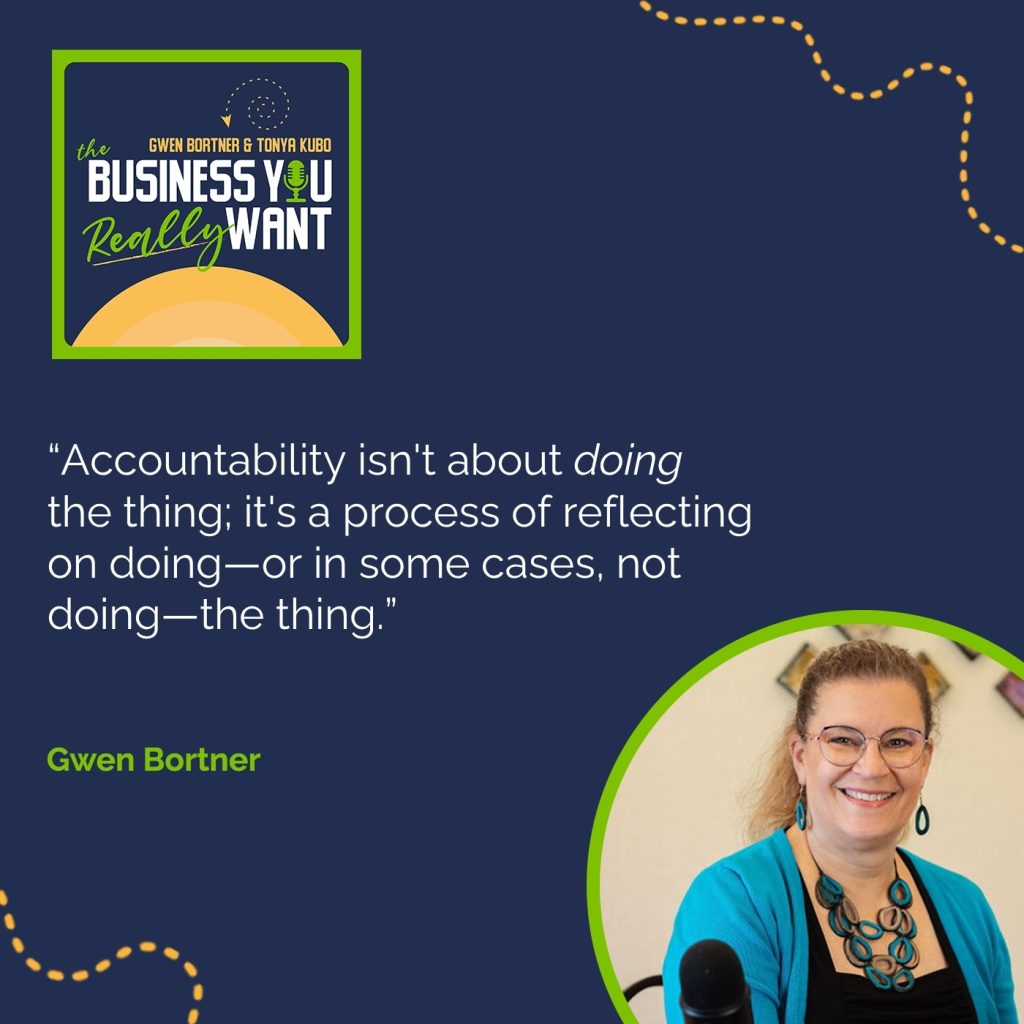
It was interesting because her perspective was like, “They should be doing their piece.” That’s the problem. We think accountability is about doing the thing, but accountability isn’t about doing the thing. It’s about the process of reflecting on doing or, in some cases, not doing, the thing, whatever that happens to be. The reflection takes two people.
Micromanaging Vs. Direction: The ‘I Don’t Parent Adults’ Myth
I want you to pause right there. When you’ve told me that story, I had a memory of an instance fairly early in my professional career when I was a brand-new manager, and I was starting to lead other leaders. I was walking through how I train people to somebody who was on my team, but more of a peer level. She was like, “I’m not going to do that.” I’m like, “What do you mean you’re not going to do that?”
It was pretty much you show them how to do it, and then you watch them do it. They do it, and then you check in on them doing it over time to see what’s going on. She was like, “I’ve got enough of my own kids. I don’t parent adults. I tell them what to do, and if they’re not going to do it, that’s on them. That’s not on me.” Pick back up.
I love that you did that because that leads to another one of my friends who was sharing a story. In this case, she was the person who was in the learning role. She was in the early stages. Her boss had the same attitude as this person that you’re describing. They were like, “I don’t parent adults.” It wasn’t even that. It was, “I don’t want to be micromanaging my people because micromanaging is evil, bad, and all the things that get said about it.”
The problem is, micromanaging has also expanded way beyond what it means to say, “Anytime I am helping you and directing you is management.” That’s not true. The person I know is competent and super capable. She ended up having to do, and I don’t think she was even exaggerating, seventeen revisions on a process deliverable thing because the boss didn’t want to be micromanaging her. That was, “I know leadership is not micromanaging, and I want to be a good leader. That would be micromanaging if I were helping her.”
It’s like, “I’m going to let you finish the whole project, and then I am going to tear it apart,” because that makes you feel good.
I’m not even going to tear it apart in detail. I’m going to say, “Maybe you should think about this other thing. Why don’t you go back and bring it back again? What about this other piece?” Back to seventeen revisions. The piece here is, in that case, they weren’t giving enough direction. What you were talking about was giving direction, not micromanaging.
Micromanaging is when this person that you have trained has been doing this job for six months, and every day, you’re like, “Did you do it exactly the way I want you to do it? Is it exactly what I needed to be?” That’s micromanaging. You’re not letting people do a job that they know how to do, that they have been trained to do, and that they’ve got the information to do. You’re watching every step. That’s the micro piece of the management piece. Giving direction, giving training, and doing any of those things is not it.
The problem here that we have with accountability is that it has gotten reduced to whether you did the task or you did not do the task. That is not accountability. That’s about whether or not people are reliable. Reliability is you know what you need to do, and you’ve done it right, or you haven’t. Sometimes, we’re not as reliable as we want to be. That’s when accountability can be valuable. It helps us figure out what prevents us from being as reliable as we want to be.
The challenge that I see that becomes the big issue, particularly in entrepreneurial businesses, is that we want our teams to be accountable, but we don’t want to have to be accountable ourselves. We want all the flexibility and all the things that we have been told entrepreneurship is supposed to be. We should be able to do whatever we want, whenever we want, and however we want.
We hired adults, so they should be able to do an adult job. We shouldn’t have to train them unless we want to train them. They should be able to know everything. They should understand all of the reasons that we do all the things we do, because why wouldn’t they? They’re so obvious to us because we’re entrepreneurs. They would know all of the reasons behind all of these things.
With the pieces that we have to do to be accountable, we often are like, “I’m not going to do it,” and then we wonder why our people aren’t accountable. It’s because accountability is a two-way street. It’s give and take. It’s got to go both directions. To me, this is the piece where, a lot of times, when accountability falls apart, the CEO, the entrepreneur, the founder, or whoever wants to blame the people, but the reason it fell apart was you.
Accountability is a two-way street. It has to give and take. Share on XThe Accountability Two-Way Street: Why Leaders Must Commit
Isn’t it the right or the privilege of the business owner or the CEO to pick and choose what they do? Isn’t that the whole structure of a team? You hire people to do what you tell them to do, but you don’t hire people to tell you what to do.
Yes, and. Part of accountability is making sure that the communication lines are clear. The only way the communication lines are clear is if you’re communicating. Real accountability, not just checking off task box things, is about communication. When you stop communicating, then how can they be accountable?
Let me try to recap a little bit and make sure that I’m tracking here. You started by saying accountability gets misdefined or misrepresented as whether you did the thing. That is reliability. I said I was going to do a thing, and I did it. That’s me being reliable. If you ask me if I did the thing, you are asking me if I’m reliable. You’re checking. It’s a trust-building exercise, so to speak. Accountability is about reflection. You also have indicated that accountability is a partnership because it’s a two-way street.
The key here is that reflection requires someone outside of your brain. Our brain will tell us whatever we want to hear. Our brains are very complicated things. True reflection takes some outside perspective.
That’s where the partnership comes between the business owner or entrepreneur and their team or maybe peers.
This is the partnership. This is the two-way street
Accountability is about reflection. Accountability is a partnership. You also said accountability is about communication.
To me, all of those three things are highly related.
Reflection, Partnership, Communication: Connecting The Core Dots
Connect the dots for me.
Back to reflection requires a partnership. We can self-reflect. I’m not saying that you can’t self-reflect, but I will bet dollars to donuts every single solitary time that you’d better reflect with somebody else. That’s because they’ll ask the question or make you think about the thing that your brain or your subconscious is preventing you from asking yourself.
Since it’s a reflection with another person, this is where the two-way street is. It’s got to go back and forth. Therefore, the communication piece of it. Accountability isn’t about whether you did the thing. It is about the reflection of doing the thing. Was it the right thing? Was it the right thing at the right time? Was it the right thing at the right time, given all of these other circumstances? If it wasn’t the thing, what was preventing it from getting done? There are a lot of questions around that. That takes a different person.
The problem of leaving the leader out, whatever the leader’s role is, in the reflection process means that we’re still within our own echo chamber. We’re at the same level, and we are both agreeing that this is the thing to do. If we are holding each other accountable, which could happen, the question is, does it align with where our leader wants us to be going? It doesn’t help us if three of us are all going way off to the left when we’re supposed to be going straight. Even though we’re all holding each other accountable for going off to the left, that’s not productive accountability.
This is the whole piece where the entrepreneur has to be involved. Where I say they have to be held accountable is that they have to be willing to commit to also being asked the questions from the people below them to make sure that they’re all staying on track together. It’s not as much of, “Are you sure you should be doing this?” but saying, “I don’t understand how this aligns with this thing.”
Back to the CEO, the entrepreneur is able to say, “I can see why you don’t see how it aligns because I’ve put 48 dots in between the thing I said and the thing you know. Here, let me draw you a path there.” Sometimes, it’s like, “The reason you can’t see the line is because there is no line. I’m distracted. It was the shiny object. It was the thing that went off here.” You have to be willing to say, “You’re right. You shouldn’t be doing that,” which is off your thing that’s not part of your world. You are reflecting back as well. You can’t say, “I’m not going to show up,” because that’s not being accountable.
Sometimes, the reason you can't see the line is because there is no line. Share on XI have a hard time picturing any boss going, “I’ve promised everybody weekly check-ins of some sort. We’ve got three big events coming up in the next month. Those weekly check-ins, that’s 30 minutes for each team member. For me, that’s going to be a total of two and a half hours a week. We could all benefit from the extra time this month focused on the three events.” I have a hard time believing that any manager would say, “Those check-ins are pointless. I’m above them. I’m afraid they’re going to ask me hard questions at those check-ins, so I’m going to cancel them all.” I don’t think anybody’s walking around going, “I don’t want to be held accountable.”
No one is saying that, but what they’re finding is that it’s hard.
Inside The Leader’s Mind: The ‘Urgent’ Trap That Kills Consistency
You’re like, “They don’t want to be held accountable,” but they’re not walking around saying that. They don’t think that, and they don’t know that’s what you’re saying. What do they know? What do they see? How do they experience it?
What they see is that often, it’s obvious to them, so why can’t it possibly be obvious to everybody else? They’re like, “It’s so obvious to me. How can they not know?” This is a classic. I tried it once, and it didn’t work. There’s not enough investment to start seeing the benefit. Any process takes some time. Partly related to shiny object syndrome is like, “I’m going to try this other thing.” I started, I got distracted, and I didn’t come back.
One of the bigger issues is that no one is, in fact, holding them accountable. No employee will not know, but almost no employee is ever going to say, “You didn’t do your thing. If I’m filling out a report that you’re supposed to review every week and then have a meeting with me, even if it’s only fifteen minutes, but you don’t do it this week because you’re like, ‘I’ve got a super important thing,’ I can understand that. They were super important.”
The next week, it doesn’t happen because you’re like, “I’ve got this other thing.” They’re like, “I get that.” By the 3rd or 4th week, they’re like, “They’re not looking at this report. We’re not going to meet.” Most employees are not going to say, “What the heck? Why are you not meeting with me? Why are you not reading this report?” because who’s holding that person accountable to do those things? It’s easy for them to say that something else is more important. We all get caught up in whatever that important, urgent thing is.
In using your examples, like, “I would be so much better off spending two and a half hours doing something else,” my question always is, “Would you? What are those two and a half hours that you’re spending with your employees going through the process going to save you in the long run? What if you’re answering questions before they become problems? What if you’re doing some of these other things?”
We aren’t thinking that we aren’t being held accountable. Who is calling us out on our action? Almost nobody. You could have an unusual employee who might be saying, “I need to know. I’m not going to let you get away with this,” but most aren’t. Most are going to say, “If they don’t care enough about it to do their piece, then why do I care enough about it to do mine?”
We don’t think that we don’t want to be held accountable, but part of it is, “I don’t want to be held to certain constraints. I should be able to make the choice.” The problem is, are you getting your own reflection to say, “Is this the best choice to be making?” Once you start getting that, some folks are like, “I don’t want you asking me this because I know what the answer is, and it’s not the answer that I want to give you.”
Stop Checking Boxes: What Real Accountability Looks Like
We’ve talked about where people get accountability wrong with the wrong definitions. We’ve talked about what it is. To recap, it’s partnership, reflection, and communication. What does doing accountability well look like? From what you are saying, most people have never seen it, so how on earth could they do it?
There’s a huge truth in that statement. They’ve seen a piece of it, and they think that’s all there is to it. Often, as the recipient of that, it was like, “That didn’t provide any value to me. Why am I going to do that to somebody else?” When someone’s like, “Let’s see your checklist. Did you do the things? I see you didn’t do those. Get those done,” it’s like, “That wasn’t valuable to me, so why am I going to do that to somebody else? They’re adults. They should be able to do the things.” That becomes the big piece.
The challenge is that most people don’t understand that the reflection part and the communication part allow you to start solving problems before they become problems. It helps people stay on task in the way that you want. When your priorities have shifted, and Heaven knows it happens a lot, it allows you to be able to realize, “They’re still going down path A, and we’re on path A2.” It’s a little bit like A, but it’s not exactly like A. Since it’s not exactly like A, if they keep going, at some point, there is going to be very divergent.
Most people don't understand that the reflection and communication part allows you to start solving problems before they become problems. Share on XThis is the biggest issue of the whole thing. Everyone on the planet, me included, thinks that we’re pretty good at communication because it is the number two milestone that we have in our lives. Walking and talking are the first two big milestones that most babies are excited and celebrated for. It is when they walk and when they talk. These are babies. We have been talking, for all practical purposes, our entire lives, so we think we’re good at it. None of us are. No matter how much energy we put toward it, we could still get better at it.
This is one of the places that allows us to start working on our communication in that accountability piece. We don’t realize, when it’s about checking boxes, that that’s not communication at all. That’s why this reflection piece is so much more important, but most people don’t talk about it in that way. What they’re doing is they’re usually using anything that could be accountability as an update.
“Did you, or didn’t you?” is a verbal version of the checklist. It is, “Where are things? Are they done? Are they not done?” instead of saying, “I see you got that done, but why did you choose that over this other project first? There’s a reason you did. I need to understand that. Let’s talk about whether that is the best priority order in the future because we’ll probably have a similar situation come up again,” or, “At least you got that done, but let’s get on this other one.”
It’s the communication piece and reflection piece that is real accountability, which takes time. This is where you don’t have to micromanage people because they understand more about the choices that they’re making. They also understand more about how you would want them to make the choices. Where it often goes wrong is that we get to the point where we’ve been doing some of this, we drop off, and then we try to play catch-up by micromanaging. Nobody likes that. Most people don’t like doing it. I hardly know anybody who likes receiving it.
It’s about the ongoing regular rhythm of communication and reflection, which is part of that communication process, that makes accountability work. When it’s working well, you aren’t having to have hard conversations at all. What’s happening over time is that everyone is getting clearer on the priorities, thought processes, and internal decision trees that are going on, so that they can adopt them as well. We don’t have to do as much work. The problem is, initially, it takes practice. We have to get some consistency in. Most people don’t stick with it long enough to get the consistency in to see where the benefit starts paying off. It can pay off fairly quickly in small ways, but it can pay off hugely over time.
The Team Won’t Hold You Accountable: How To Gain Consistency
How do they get the consistency?
They’ve got to have some form of accountability themselves. It could be their coach. It could be a person above them. It could be another peer that’s trying to implement a similar system to say, “Double check that I’m doing this,” or any way of that happening. It can be the team, so long as the team believes that you want to be held accountable.
How do you convince your team you want to be held accountable?
It almost never works.
Maybe we shouldn’t offer that as an option then if it almost never works.
Where it can work is where some of your team are like you and me. You’re not an employee. You’re an independent contractor. You’re an entrepreneur. You come into this relationship so much more like a peer than an employee. We do have an accountability process. You can hold me accountable in the accountability process because you come in very much like a peer, and I treat you like a peer.
Sophia, who’s lovely, and we love Sophia, would not think of herself as a peer. I would not think of her as a peer. Even if I told her to hold me accountable, she would not be able to hold me accountable, even though she knows that I’m good to my word. I haven’t ever presented saying, “Hold me accountable,” and then she gets yelled at. None of those things has ever happened to her. There’s no reason that she would doubt that I wanted her to hold her accountable, but there is a power differential.
I’m glad you brought up Sophia as an example. What we’re talking about is that it can be your EA, but not necessarily. It’s hard to have somebody hold you accountable who, one, doesn’t know the signs or symptoms. I’m thinking of Sophia specifically. Why Sophia wouldn’t be good at that is part of it is the power differential. Sophia is early in her career. She is somebody who is like, “Gwen’s the boss.” She doesn’t want to make you mad because she likes you a lot and all those things. Part of it is also that she doesn’t know what it looks like when an entrepreneur gets in their own way.
She is always going to assume that you didn’t do what you said you were going to do because you got pulled into a different direction. At her stage, she sees entrepreneurs get pulled in 100 different directions. She is going to assume that you got pulled in that direction for good reason, and she is also going to assume that that good reason is not her business. All of those things are going to make her not even think about the fact that you didn’t do what you said you were going to do. It’s not that she’ll say, “Gwen said she was going to do this, but it’s not my place to ask.” It’s so in her mind, not her place, that she wouldn’t even have the question pop up.
That’s the piece. If you find that you try to implement things that require consistency on your part as an entrepreneur, and they fall apart, and you want to blame everybody else, the first question is, were you doing your piece consistently or not? I’m not saying even if you had a good reason. The only good reasons are always, in my world, fire, flood, and blood. The good reason is, “The house was flooded.” The good reason was, ‘My husband was in the hospital.” The good reason wasn’t, “We have a big event coming. I needed the time back.” That’s not a good reason.
It sounds like a good reason, though.
It does sound like a very good reason. That’s why I said they have to be truly a good reason, which, to me, is fire, flood, or blood. It has to be at that level. If you find, at some point, you’re always losing it, then it’s probably you and not them. That means you need someone to hold you accountable to doing the piece to be able to get that done.
With all of that being said, how do you fix it? You’re that person. You’re in this rinse and repeat cycle of, “We start a thing, and it falls apart.” Maybe it falls apart for the exact reason that you said. We’re trying to get time back because we’ve got something big happening. Maybe it’s because, “Look. Shiny.” Maybe it’s because we’ve got that person on the team who hates doing it, hates the accountability process, whatever it is, and they’re vocal about hating it. We’re sick and tired of hearing them, so we’re like, “We’re going to stop doing it, so we don’t have to hear them complain.” Regardless of why it falls apart, because why it falls apart is not nearly as important as figuring out how you fix it and how you get back on track.
We’ve heard it a thousand times. Every therapist needs a therapist. Every coach needs a coach. Every person who is holding a team accountable needs someone to hold them accountable.
Every person that is holding a team accountable needs someone to hold them accountable. Share on XFire, Flood, And Blood: The 3 Qualities Your Accountability Partner Needs
Pause there, and tell us how we find that person. What qualities do they need to have? Let’s say here at my house, there are some big projects we want to take on. It means that we need to save up a little money to take on these big projects because they cost money. I have another adult who lives in my house. He’s my husband. He contributes income. His name’s on the bank account and the debit cards. My husband is a wonderful man who has many gifts in this world. Holding me accountable to savings and a budget is not one of those gifts.
That’s a place where you would need some outside perspective, someone that you would trust, that you would respect, and that you would listen to. This is where sometimes I say, “Maybe you don’t want to be held accountable. That’s okay, but then you can’t be mad when the rest of your team isn’t being held accountable.” This is back to, “Are you going to do the thing that needs to be done?”
In using this as an example, you need to have someone who will ask you the question, help you understand what’s preventing you from saving money if that is going on, and is able to help you reflect on that and problem-solve on that. That’s another reason why not everybody can hold you accountable. Someone may be able to hold you accountable to one thing. Someone else may not be able to hold you accountable, but they can hold you to another thing.
You need someone who can help you think through it. This is that reflection piece. They’ve got to have enough experience, knowledge, and understanding of whatever this issue is to be able to help you reflect on it. They don’t necessarily have to be better at it than you, which is one of the things that people always assume, but they do have to be willing to show up in a consistent way.
That’s the place where a lot of these things fall apart. It is, “I’m going to do this with my buddy who is an entrepreneur.” Is it in their natural tendency to do this? If it is, then maybe this won’t be a problem. If it isn’t, who is holding them accountable to make sure that you’re being held accountable? Sometimes, this is why we pay people for certain things. What’s making sure that they’re holding you accountable is that you’re paying them X amount every week, month, year, or whatever the process is. If they don’t, then you can say, “I paid you for this. You’re not doing this. I’m no longer paying you for this.”
When we’re doing the buddy thing, unless you have an equal thing that you are holding each other accountable for, and you both care enough about it and are more natural about one than the other, then often, it ends up not being an even exchange of energy. A lot of times, when accountability systems fall apart, it is because one person can’t hold it for both people forever. At some point, they get exhausted if they’re not getting some version of accountability, and it may not be directly accountability, but some version of accountability, back into the equation.
For me, I’ve always been fairly naturally accountable. I’ve got good boundaries. I am very good at showing up. There are certain things that make this relatively easy for me. I’ve started accountability groups that have gone on for long times. People are always like, “How does that happen?” It’s because when I make that kind of commitment, I can keep that kind of commitment. There’s usually a point where I no longer want to be doing it because I’m carrying all the burden of the accountability, and no one is helping me be accountable back.
Nobody’s refilling the cup.
That’s what a lot of coaches are doing. They’re holding a space of accountability around certain topics. Using your finances as an example, you could hire a finance coach who would be looking at your numbers. If they were truly holding you accountable, it wouldn’t be, “Did you or didn’t you?” It would be, “Did you? How did that work? What were the things that were working about it? What about that can be replicated in other ways?
What part didn’t work? What was preventing that from working? Are there things that we learned on the working side that would help us on the non-working side?” It’s a reflection process, and that’s the piece that almost everybody misses. We hear so many times people talk about, “We hold our people accountable,” and when you check, they’re not holding them accountable. They’re just seeing if they’re doing the thing.
It could also be that they’re having them turn in checklists every week.
That’s not accountability. That’s reporting.
The Bottom Line: Your Next Steps To Rebuilding Accountability
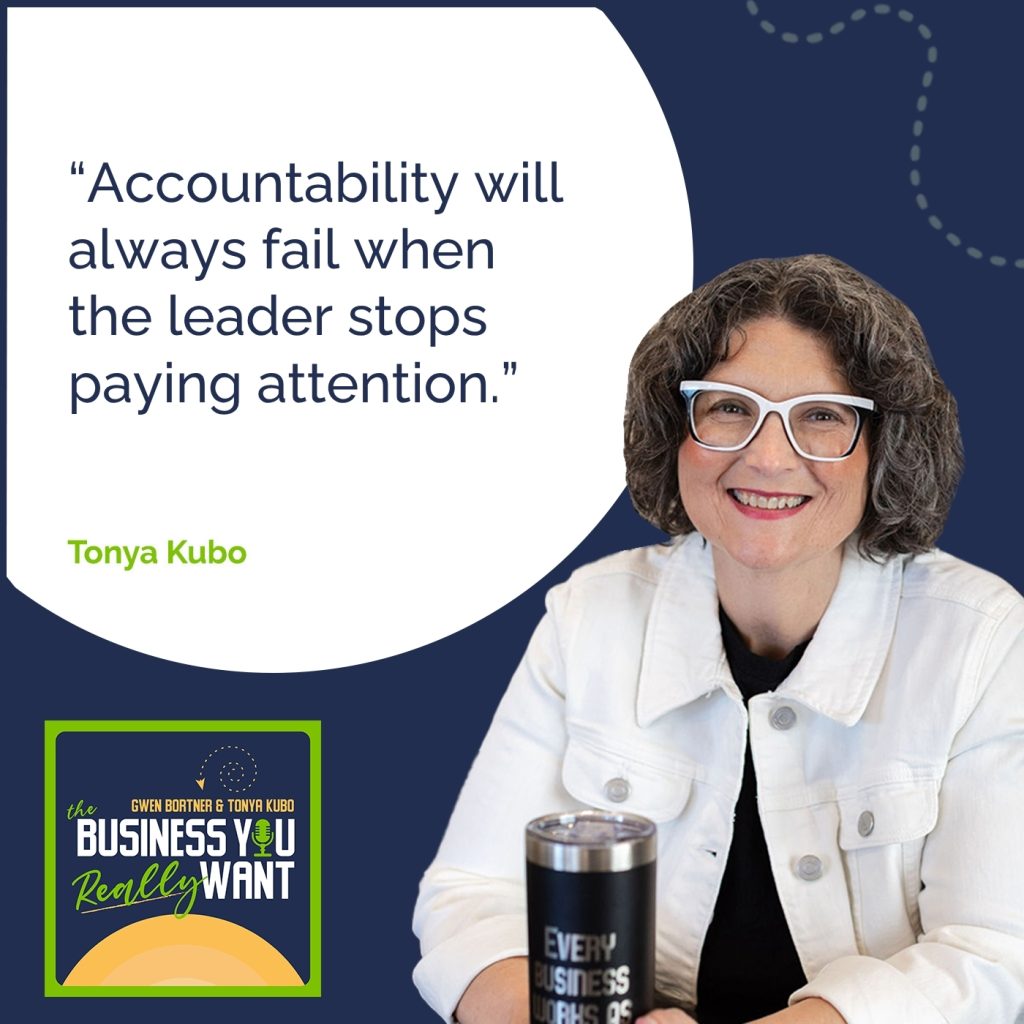
We are out of time. The bottom line here is that accountability will always fail when the leader stops paying attention. If you’re a solopreneur, you probably already have somebody who is holding you accountable because you don’t have a team for that feedback loop. For those of you who have a team, you have to know that if it’s hard to manage your team, it’s likely because you have stopped paying attention to parts of the process that are important, or at least look important, to your team. They take their cues from you. If you disengage, they disengage. When you stay consistent, even in small ways, you signal to them that the work matters, they matter, and the system is worth doing and worth trusting.
If you’ve been reading and you’re like, “That happens in my business, too,” and you notice that accountability slips often, maybe your team stops checking in, or maybe you find, “I lose my motivation to follow through,” it is time to reset. You can go and reset all by yourself. You can take what we’ve talked about. You can check our other episode on accountability and do that reset yourself, or you can get that outside perspective. A clarity call with Gwen is a great place to start for an outside perspective. In one session, you’ll uncover why accountability keeps breaking down for you. Your reason for losing accountability would be different than mine. You can figure out how to rebuild a system that sticks.
I should also add that if you are somebody who has a team and you don’t want just accountability for yourself, but you want to learn how to hold the team accountable, you want a clarity call with Gwen, too. She teaches this process to other business owners and other managers. You’re going to book your clarity call at EverydayEffectiveness.com/clarity so that you can start leading with consistency that creates results, or at the very least, you get a little bit of that outside perspective that can be so valuable.
Mentioned in This Episode
- True Accountability – The Secret To Sustainable Success
- Schedule a Clarity Call with Gwen Bortner
- The Business You Really Want on Apple Podcasts
About Your Hosts
Gwen Bortner has spent four decades advising executives and entrepreneurs in 45+ industries. She helps women succeed in business without sacrificing happiness by identifying their true desires and aligning their business functions. She spots overlooked bottlenecks and crafts efficient plans toward sustainable success that center your values and priorities. Known for her unique approach to problem-solving and accountability through the G.E.A.R.S. framework, Gwen empowers clients to achieve their definition of success without sacrificing what matters most.
Tonya Kubo is a marketing strategist and community builder who helps entrepreneurs build thriving online communities. As co-host of The Business You Really Want and Chief Marketing and Operations Officer (CMOO) at Everyday Effectiveness, she keeps conversations on track and ensures complex business concepts are accessible to everyone. A master facilitator with 18+ years of experience in online community building, Tonya takes a people-first approach to marketing and centers the human experience in all she does.
